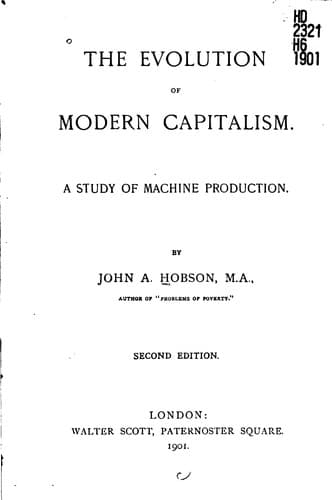
The Evolution of Modern Capitalism: A Study of Machine ProductionHobson, J. A. (John Atkinson)
History
The Evolution of Modern Capitalism: A Study of Machine Production
Hobson, J. A. (John Atkinson)
Capitalism; Industries -- History; Machinery in the workplace
"The water frame, the carding engine, and the other machines which
Arkwright brought out in a finished state, required both more space
than could be found in a cottage, and more power than could be applied
by the human arm. Their weight also rendered it necessary to place
them in strongly-built walls, and they also could not be
advantageously turned by any power then known but that of water.
Further, the use of machinery was accompanied by a greater division of
labour, and therefore a greater co-operation was requisite to bring
all the processes of production into harmony and under a central
superintendence."[60] Hence the growth of machine-production is to a
large extent synonymous with the growth of the modern Factory System.
§ 3. Man does his work by moving matter. Hence machinery can only aid
him by increasing the motive power at his disposal.
(1) Machinery enables forces of man or nature to be more effectively
applied by various mechanical contrivances composed of levers,
pulleys, wedges, screws, etc.
(2) Machinery enables man to obtain the use of various motor forces
outside his body--wind, water, steam, electricity, chemical action,
etc.[61]
Thus by the provision of new productive forces, and by the more
economical application of all productive forces, machinery improves
the industrial arts.
Machinery can increase the scope of man's productive ability in two
ways. The difficulty of concentrating a large mass of human force upon
a given point at the same time provides certain quantitative limits to
the productive efficiency of the human body. The steam-hammer can
perform certain work which is quantitatively outside the limit of the
physical power of any number of men working with simple tools and
drawing their motor power from their own bodies. The other limit to
the productive power of man arises from the imperfect continuity of
human effort and the imperfect command of its direction. The
difficulty of maintaining a small, even, accurate pressure, or a
precise repetition of the same movement, is rather a qualitative than
a purely quantitative limit. The superior certainty and regularity of
machinery enables certain work to be done which man alone could not do
or could do less perfectly. The work of the printing machine could not
be achieved by man. Machinery has improved the texture and quality of
certain woollen goods;[62] recent improvements in milling result in
improved quality of flour and so on. Machinery can also do work which
is too fine or delicate for human fingers, or which would require
abnormal skill if executed by hand. Economy of time, which Babbage[63]
accounts a separate economy, is rightly included in the economies just
named. The greater rapidity with which certain manufacturing
processes--_e.g._, dyeing--can be achieved arises from the superior
concentration and continuity of force possible under machinery. All
advantages arising from rapid transport are assignable to the same
causes.
Public-domain text, read in full here on John Shaqi.
Reviews
Reviews
No reviews yet
Be the first to share your thoughts on this work.
Join the Discussion
Join the discussion
Sign in to leave a comment or review.
Sign InorCreate an account