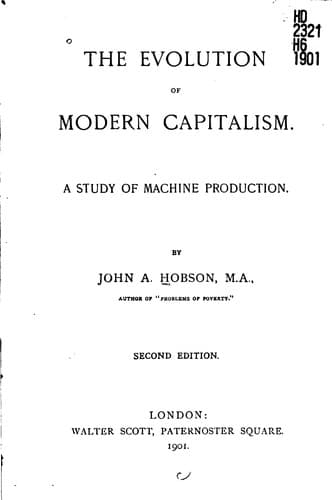
The Evolution of Modern Capitalism: A Study of Machine ProductionHobson, J. A. (John Atkinson)
History
The Evolution of Modern Capitalism: A Study of Machine Production
Hobson, J. A. (John Atkinson)
Capitalism; Industries -- History; Machinery in the workplace
The continuity and regularity of machine work are also reflected in
certain economies of measurement. The faculty of self-registering,
which belongs potentially to all machinery, and which is more utilised
every day, performs several services which may be summed up by saying
that they enable us to know exactly what is going on. When to
self-registration is applied the faculty of self-regulation, within
certain limits a new economy of force and knowledge is added. But
machinery can also register and regulate the expenditure of human
power. Babbage well says:--"One of the most singular advantages we
derive from machinery is in the check which it affords against the
inattention, the idleness, or the knavery of human agents."[64] This
control of the machine over man has certain results which belong to
another aspect of machine economy.[65]
These are the sources of all the improvements of economies imputed to
machine-production. All improvements in machinery, as applied to
industrial arts, take therefore one of the following forms:--
(1) Re-arrangement or improvement of machinery so as to utilise more
fully the productive power of nature or man. Improvements enabling one
man to tend more spindles, or enabling the same engine at the same
boiler-pressure to turn more wheels, belong to this order of
improvement.
(2) Economies in the source of power. These will fall under four
heads--
1. Substitution of cheaper for dearer kinds of human power.
Displacement of men's labour by women's or children's.
2. Substitution of mechanical power for human power. Most
great improvements in the "labour-saving" character of
machinery properly come under this head.
3. Economies in fuel or in steam. The most momentous
illustration is the adoption of the hot blast and the
substitution of raw coal for coke in the iron trade.[66]
4. The substitution of a new mechanical motor for an old one
derived from the same or from different stores of
energy--_e.g._, steam for water power, natural gas for
steam.
Public-domain text, read in full here on John Shaqi.
Reviews
Reviews
No reviews yet
Be the first to share your thoughts on this work.
Join the Discussion
Join the discussion
Sign in to leave a comment or review.
Sign InorCreate an account