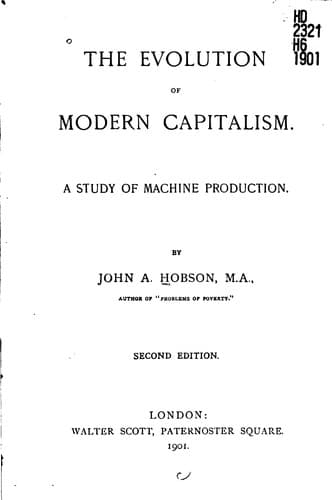
The Evolution of Modern Capitalism: A Study of Machine ProductionHobson, J. A. (John Atkinson)
History
The Evolution of Modern Capitalism: A Study of Machine Production
Hobson, J. A. (John Atkinson)
Capitalism; Industries -- History; Machinery in the workplace
(3) Extended application of machinery. New industrial arts owing their
origin to scientific inventions and their practice to machinery arise
for utilising waste products. Under "waste products" we may include
(_a_) natural materials, the services of which were not recognised or
could not be utilised without machinery--_e.g._, nitrates and other
"waste" products of the soil; (_b_) the refuse of manufacturing
processes which figured as "waste" until some unsuspected use was
found for it. Conspicuous examples of this economy are found in many
trades. During the interval between great new inventions in machinery
or in the application of power many of the principal improvements are
of this order. Gas tar, formerly thrown into rivers so as to pollute
them, or mixed with coal and burnt as fuel, is now "raw material for
producing beautiful dyes, some of our most valued medicines, a
saccharine substance three hundred times sweeter than sugar, and the
best disinfectants for the destruction of germs of disease." "The
whole of the great industries of dyeing and calico-printing have been
revolutionised by the new colouring matters obtained from the old
waste material gas tar."[67] These economies both in fuel and in the
utilisation of waste material are largely due to the increased scale
of production which comes with the development of machine industry.
Many waste products can only be utilised where they exist in large
quantities.
§ 4. If we trace historically the growth of modern capitalist
economies in the several industries we shall find that they fall
generally into three periods--
1. The period of earlier mechanical inventions, marking the
displacement of domestic by factory industry.
2. The evolution of the new motor in manufacture. The
application of steam to the manufacturing processes.
3. The evolution of steam locomotion, with its bearing on
industry.
As these periods are not materially exclusive, so also there are close
economic relations subsisting between the development of machinery and
motor, and between the improvements in manufacture and in the
transport industry. But in order to understand the nature of the
irregularity which is discernible in the history of the development of
machinery, it is essential to consider these factors both separately
and in the historical and economic relation they stand to each other.
For this purpose we will examine two large staple industries, the
textile and the iron industries of England, in order that we may trace
in the chief steps of their progress the laws of the evolution of
modern machinery.
Public-domain text, read in full here on John Shaqi.
Reviews
Reviews
No reviews yet
Be the first to share your thoughts on this work.
Join the Discussion
Join the discussion
Sign in to leave a comment or review.
Sign InorCreate an account