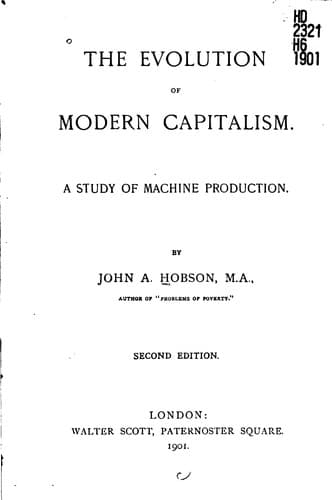
The Evolution of Modern Capitalism: A Study of Machine ProductionHobson, J. A. (John Atkinson)
History
The Evolution of Modern Capitalism: A Study of Machine Production
Hobson, J. A. (John Atkinson)
Capitalism; Industries -- History; Machinery in the workplace
Although the origin and application of inventive genius is largely
independent of known laws, and may provisionally be relegated to the
domain of "accident," there are certain reasons which favoured the
cotton industry in the industrial race. Its concentration in South
Lancashire and Staffordshire, as compared with the wide diffusion of
the woollen industries, facilitated the rapid acceptance of new
methods and discoveries. Moreover, the cotton industry being of later
origin, and settling itself in unimportant villages and towns, had
escaped the influence of official regulations and customs which
prevailed in the woollen centres and proved serious obstacles to the
introduction of new industrial methods.[71] Even in Lancashire itself
official inspectors regulated the woollen trade at Manchester,
Rochdale, Blackburn, and Bury.[72]
The cotton industry had from the beginning been free from all these
fetters. The shrewd, practical business character which marks
Lancashire to-day is probably a cause as well as a result of the great
industrial development of the last hundred years.
Moreover, it was recognised, even before the birth of the great
inventions, that cotton goods, when brought into free competition with
woollen goods, could easily undersell them and supplant them in
popular consumption. This knowledge held out a prospect of untold
fortune to inventors who should, by the application of machinery,
break through the limitations imposed upon production by the
restricted number of efficient workers in some of the processes
through which the cotton yarn must pass.
But the stimulus which one invention afforded to another gave an
accumulative power to the application of new methods. This is
especially seen in the alternation of inventions in the two chief
processes of spinning and weaving.
Even before the invention of John Kay's Fly Shuttle, which doubled the
quantity of work a weaver could do in a day, we found that spinners
had great difficulties in supplying sufficient yarn to the weavers.
This seems to have applied both to the Lancashire cotton and to the
Yorkshire woollen manufactures. After the fly-shuttle had come into
common use this pressure of demand upon the spinners was obviously
increased, and the most skilful organisation of middleman-clothiers
was unable to supply sufficient quantities of yarn. This economic
consideration directed more and more attention to experiments in
spinning machinery, and so we find that, long before the invention of
the jenny and the water-frame, ingenious men like John Kay of Bury,
Wyatt, Paul, and others had tried many patents for improved spinning.
The great inventions of Hargreaves and Arkwright and Crompton enabled
spinning to overtake and outstrip weaving and when, about 1790, steam
began to be applied to considerable numbers of spinning mills, it was
no longer spinning but weaving that was the limiting process in the
manufacture of woollen and cotton cloths.
Public-domain text, read in full here on John Shaqi.
Reviews
Reviews
No reviews yet
Be the first to share your thoughts on this work.
Elsewhere in the archive
Join the Discussion
Join the discussion
Sign in to leave a comment or review.
Sign InorCreate an account