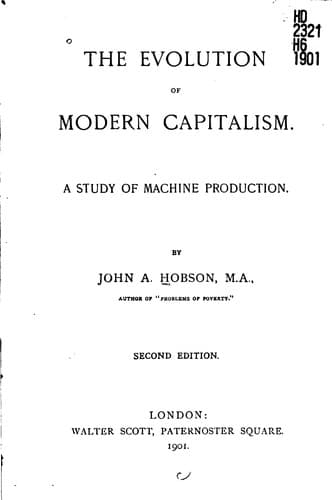
The Evolution of Modern Capitalism: A Study of Machine ProductionHobson, J. A. (John Atkinson)
History
The Evolution of Modern Capitalism: A Study of Machine Production
Hobson, J. A. (John Atkinson)
Capitalism; Industries -- History; Machinery in the workplace
This strain upon weaving, which had been tightening through the period
of the great spinning improvements, acted as a special incentive to
Cartwright, Horrocks, and others to perfect the power-loom in its
application, first to woollen, then to cotton industries. Not until
well into the nineteenth century, when steam power had been fully
applied by many minor improvements, were the arts of spinning and
weaving brought fully into line. The complete factory, where the
several processes of carding, spinning, weaving (and even dyeing and
finishing), are conducted under the same roof and worked in
correspondence with one another, marks the full transition from the
earlier form of domestic industry, where the family performed with
simple tools their several processes under the domestic roof.[73]
§ 6. The history of these textile inventions does a good deal to
dispel the "heroic" theory of invention--that of an idea flashing
suddenly from the brain of a single genius and effecting a rapid
revolution in a trade. No one of the inventions which were greatest in
their effect, the jenny, the water-frame, the mule, the power-loom,
was in the main attributable to the effort or ability of a single man;
each represented in its successful shape the addition of many
successive increments of discovery; in most cases the successful
invention was the slightly superior survivor of many similar attempts.
"The present spinning machinery which we now use is supposed to be a
compound of about eight hundred inventions. The present carding
machinery is a compound of about sixty patents."[74] This is the
history of most inventions. The pressure of industrial circumstances
direct the intelligence of many minds towards the comprehension of
some single central point of difficulty, the common knowledge of the
age induces many to reach similar solutions: that solution which is
slightly better adapted to the facts or "grasps the skirts of happy
chance" comes out victorious, and the inventor, purveyor, or, in some
cases, the robber is crowned as a great inventive genius. It is the
neglect of these considerations which gives a false interpretation to
the annals of industrial invention by giving an irregular and
catastrophic appearance to the working of a force which is in its
inner pressure much more regular than in its outward expression. The
earlier increments of a great industrial invention make no figure in
the annals of history because they do not pay, and the final increment
which reaches the paying-point gets all the credit, though the
inherent importance and the inventive genius of the earlier attempts
may have been as great or greater.
Public-domain text, read in full here on John Shaqi.
Reviews
Reviews
No reviews yet
Be the first to share your thoughts on this work.
Elsewhere in the archive
Join the Discussion
Join the discussion
Sign in to leave a comment or review.
Sign InorCreate an account