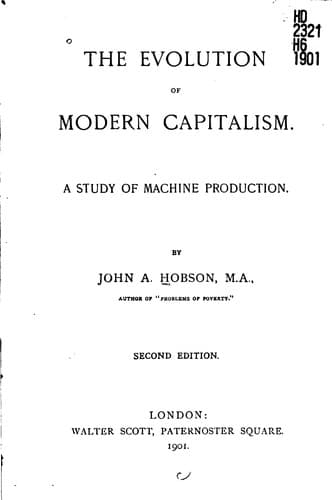
The Evolution of Modern Capitalism: A Study of Machine ProductionHobson, J. A. (John Atkinson)
History
The Evolution of Modern Capitalism: A Study of Machine Production
Hobson, J. A. (John Atkinson)
Capitalism; Industries -- History; Machinery in the workplace
Thus in a given trade where there are several important processes, an
improvement in one process which places it in front of the others
stimulates invention in the latter, and each in its turn draws such
inventive intelligence as is required to bring it into line with the
most highly-developed process. Since the later inventions, with new
knowledge and new power behind them, often overshoot the earlier ones,
we have a certain law of oscillation in the several processes which
maintains progress by means of the stimulus constantly applied by the
most advanced process which "makes the pace." There is nothing
mysterious in this. If one process remains behind in development each
increment of inventive effort successfully applied there brings a
higher remuneration than if applied to any of the more forward
processes. So the movement is amenable to the ordinary law of "Supply
and Demand" enforced by the usual economic motives. As the invention
of the fly-shuttle gave weaving the advantage, more and more attention
was concentrated upon the spinning processes and the jenny was
evolved; the deficiency of the jenny in spinning warp evolved the
water-frame, which for the first time liberated the cotton industry
from dependence upon linen warp: the demand for finer and more uniform
yarns stimulated the invention of the mule. These notable improvements
in spinning machinery, with their minor appendages, placed spinning
ahead of weaving, and stimulated the series of inventions embodied in
the power-loom. The power-loom was found to be of comparatively little
service until the earlier processes of dressing and sizing had been
placed on a level of machine development by the efforts of Horrocks
and others. Not until after 1841 was an equilibrium reached in the
development of the leading processes. So likewise each notable advance
in the machinery for the main processes has had the effect of bringing
an increase of inventive energy to bear upon the minor and the
subsidiary processes--bleaching, dyeing, printing, etc. Even now the
early process of "ginning" has not been brought fully into line in
spite of the prodigious efforts, made especially in the United States,
to overcome the difficulties involved in this preparatory stage of the
cotton industry.
The following schedule will serve to show the relation of the growth
of the cotton industry as measured by consumption of raw cotton to the
leading improvements of machinery.
Public-domain text, read in full here on John Shaqi.
Reviews
Reviews
No reviews yet
Be the first to share your thoughts on this work.
Elsewhere in the archive
Join the Discussion
Join the discussion
Sign in to leave a comment or review.
Sign InorCreate an account