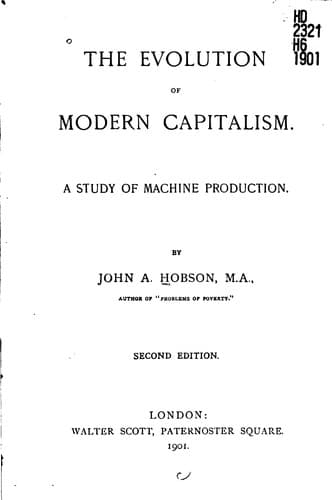
The Evolution of Modern Capitalism: A Study of Machine ProductionHobson, J. A. (John Atkinson)
History
The Evolution of Modern Capitalism: A Study of Machine Production
Hobson, J. A. (John Atkinson)
Capitalism; Industries -- History; Machinery in the workplace
Cotton Imported. Inventions &c.
lbs.
1730 1,545,472 1730 Wyatt's roller-spinning (patented
1738).
1738 Kay's fly-shuttle.
1741 1,645,031 1748 Paul's carding-machine (useless until
improved by Lees, Arkwright,
Wood, 1772-74).
1764 3,870,392 1764 Hargreave's spinning-jenny (patented
1770), for weft only.
1764 Calico-printing introduced into
Lancashire.
1768 Arkwright perfects Wyatt's
spinning-frame (patented 1769),
liberating cotton from dependence on
linen warp.
1771 }
to } 4,764,589 1771 Arkwright's mill built at Cromford.
1775 }
1775 Arkwright takes patents for carding,
drawing, roving, spinning.
1779 Crompton's mule completed (combining
jenny and water-frame, producing finer
and more even yarn).
1781 5,198,775
1785 18,400,384 1785 Cartwright's power-loom.
Watt and Boulton's first engine for
cotton-mills.
1792 34,907,497 1792 Whitney's saw-gin.
1813 51,000,000 1813 Horrocks' dressing-machine.
1830 261,200,000 1830 The "Throstle" (almost exclusively
used in England for spinning warp).
1832 287,800,000 1832 Roberts' self-acting mule perfected.
1841 489,900,000 1841 Bullough's improved power-loom.
Ring spinning (largely used in U.S.A.,
recently introduced into Lancashire).
From this schedule it is evident that the history of this trade may be
divided with tolerable accuracy into four periods.
(1) The preparatory period of experimental inventions of Wyatt, Paul,
etc., to the year 1770.
(2) 1770 to 1792 (_circa_), the age of the great mechanical
inventions.
(3) 1792 to 1830, the application of steam power to manufacture and
improvements of the great inventions.
(4) 1830 onward, the effect of steam locomotion upon the industry
(1830, the opening of the Liverpool and Manchester railway).
If we measure the operation of these several industrial forces within
these several periods, as they are reflected on the growing size of
the cotton industry, we shall realise the accumulative character of
the great industrial movement, and form some approximately accurate
conception of the relative importance of the development of mechanical
inventions and of the new motor-power.
Public-domain text, read in full here on John Shaqi.
Reviews
Reviews
No reviews yet
Be the first to share your thoughts on this work.
Elsewhere in the archive
Join the Discussion
Join the discussion
Sign in to leave a comment or review.
Sign InorCreate an account