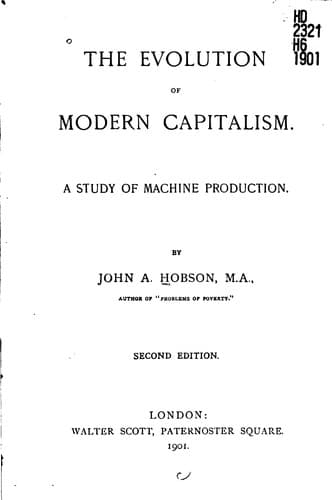
The Evolution of Modern Capitalism: A Study of Machine ProductionHobson, J. A. (John Atkinson)
History
The Evolution of Modern Capitalism: A Study of Machine Production
Hobson, J. A. (John Atkinson)
Capitalism; Industries -- History; Machinery in the workplace
Even in the coarser silk fabrics where weaving machinery was
successfully applied at an early date, the slow progress in "throwing"
greatly retarded the expansion of the trade, and after the repeal of
the duty on imported silk in 1826 the number of throwing mills was
still quite inadequate to keep pace with the demands of the
weavers.[76] Subsequent improvements in throwing mills, and the
application of the ingenious weaving machinery of Jacquard and later
improvers, have given a great expansion to many branches of the trade
in the last fifty years.
But the following statistics of the consumption of raw and thrown silk
from 1765 to 1844 indicate how slight and irregular was the expansion
of the trade in England during the era of the great inventions and the
application of the steam-motor, and how disastrously the duties upon
raw and thrown silks weighed upon this branch of manufacture.
AVERAGE IMPORTATION.[77]
lbs. lbs.
1765 } | 1823 2,468,121
1766 } 715,000 | 1824 4,011,048[78]
1767 } | 1825 3,604,058
1785 } | 1826 2,253,513
1786 } 881,000 | 1827 4,213,153
1787 } | 1828 4,547,812
1801 } | 1829 2,892,201
to } 1,110,000 | 1830 4,693,517
1812 } | 1831 4,312,330
1814 2,119,974 | 1832 4,373,247
1815 1,475,389 | 1833 4,761,543
1816 1,088,334 | 1834 4,522,451
1817 1,686,659 | 1835 5,788,458
1818 1,922,987 | 1836 6,058,423
1819 1,848,553 | 1837 4,598,859
1820 2,027,635 | 1838 4,790,256
1821 2,329,808 | 1839 4,665,944
1822 2,441,563 | 1840 4,819,262
In the linen industry the artificial encouragement given to the Irish
trade, which, bounty-fed and endowed with a monopoly of the British
markets, was naturally slow to adopt new methods of production, and
the uncertain condition of the English trade, owing to the strong
rivalry of cotton, prevented the early adoption of the new machine
methods. Although Adam Smith regarded linen as a promising industry,
it was still in a primitive condition. Not until the very end of the
eighteenth century were flax spinning mills established in England and
Scotland, and not until after 1830 was power-loom weaving introduced,
while the introduction of spinning machinery into Ireland upon a scale
adequate to supply the looms of that country took place a good deal
later.
Public-domain text, read in full here on John Shaqi.
Reviews
Reviews
No reviews yet
Be the first to share your thoughts on this work.
Elsewhere in the archive
Join the Discussion
Join the discussion
Sign in to leave a comment or review.
Sign InorCreate an account