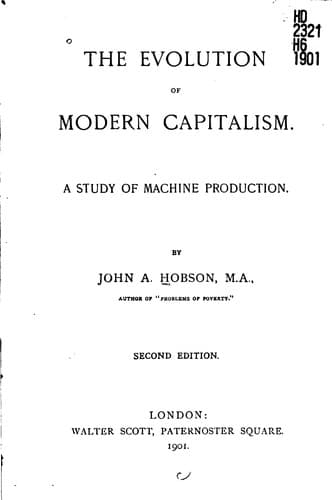
The Evolution of Modern Capitalism: A Study of Machine ProductionHobson, J. A. (John Atkinson)
History
The Evolution of Modern Capitalism: A Study of Machine Production
Hobson, J. A. (John Atkinson)
Capitalism; Industries -- History; Machinery in the workplace
We see that the early experimental period in the cotton industry
produced no very palpable effect upon the volume of the trade. Between
1700 and 1750 the manufacture was stagnant.[79] The woollen
manufacture, owing largely to the stimulus of the fly-shuttle, showed
considerable expansion. The great increase of cotton production in
1770-90 measures the force of the mechanical inventions without the
aid of the new motor. The full effects of the introduction of steam
power were retarded by the strain of the French war. Though 1800 marks
the beginning of a large continuous expansion in both cotton and
woollen manufactures, it was not until about 1817, when the new motor
had established itself generally in the large centres of industry and
the energy of the nation was called back to the arts of peace, that
the new forces began to fully manifest their power. The period 1840
onwards marks the effect of the revolution in commerce due to the
application of the new motor to transport purposes, the consequent
cheapening of raw material, especially of cotton, the opening up of
new markets for the purchase of raw material and for the sale of
manufactured goods. The effect of this diminished cost of production
and increased demand for manufactured goods upon the textile trades is
measured by the rapid pace of the expansion which followed the opening
of the early English railways and the first establishment of
steam-ship traffic.
§ 8. The development of the textile trades, and that of cotton in
particular, arose from the invention of new machinery. This machinery
was quickened and rendered effective by the new motor. The iron trade
in its development presents the reverse order. The discovery of a new
motor was the force which first gave it importance. The mechanical
inventions applied to producing iron were stimulated by the
requirements of the new motor.
In 1740 the difficulty of obtaining adequate supplies of timber, and
the failure of attempts to utilise pit-coal, had brought the iron
trade to a very low condition. According to Scrivener, at this time
"the iron trade seemed dwindling into insignificance and
contempt."[80]
The earlier steps in its rise from this degradation are measured by
the increased application of pit-coal and the diminished use of
charcoal.
The progress may be marked as follows:--
(1) The application of Watt's earlier improvements upon Newcomen's
engines, patented 1769, was followed by a rise in the average output
for furnaces worked with charcoal. The average output of 294 tons in
1750 was increased to 545 tons in 1788.
(2) The substitution of coke for charcoal proceeding _pari passu_ with
improved methods of smelting yielded an average output for coke-fed
furnaces of 903 tons in 1788. To this epoch belong also Cort's
inventions for puddling and rolling (patented 1783-84), which
revolutionised the production of bar-iron.
Public-domain text, read in full here on John Shaqi.
Reviews
Reviews
No reviews yet
Be the first to share your thoughts on this work.
Elsewhere in the archive
Join the Discussion
Join the discussion
Sign in to leave a comment or review.
Sign InorCreate an account