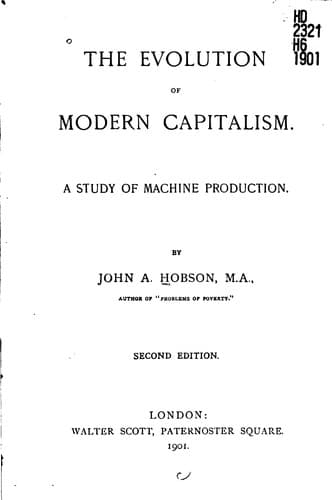
The Evolution of Modern Capitalism: A Study of Machine ProductionHobson, J. A. (John Atkinson)
History
The Evolution of Modern Capitalism: A Study of Machine Production
Hobson, J. A. (John Atkinson)
Capitalism; Industries -- History; Machinery in the workplace
Another great economic advantage which assisted England was the fact
that she, more than any other European nation, had broken down the old
industrial order, with its guilds, its elaborate restrictions, and
conservative methods. Personal freedom, security of property, liberty
to work and live where and how one liked, existed in England to an
extent unknown on the Continent before the French Revolution. The
following account of the condition of the cotton manufacture in
Germany in the eighteenth century will serve to indicate the obstacles
to the reformed methods of industry:--"Everything was done by rule.
Spinning came under public inspection, and the yarn was collected by
officials. The privilege of weaving was confined to the confraternity
of the guild. Methods of production were strictly prescribed; public
inspectors exercised control. Defects in weaving were visited with
punishment. Moreover, the right of dealing in cotton goods was
confined to the confraternity of the merchant guild: to be a
master-weaver had almost the significance of a public office. Besides
other qualifications, there was the condition of a formal examination.
The sale also was under strict supervision; for a long time a fixed
price prevailed, and a maximum sale was officially prescribed for each
dealer. The dealer had to dispose of his wares to the weaver, because
the latter had guaranteed to him a monopoly of the export trade."[91]
Under such conditions the new machine-industry could make little
advance. Excepting in the case of the woollen industries, England had
for the most part already shaken off the old regulations before 1770.
In particular, the cotton trade, which was in the vanguard of the
movement, being of recent growth and settling outside the guild towns,
had never known such restrictions, and therefore lent itself to the
new order with a far greater facility than the older trades. Moreover,
England was free from the innumerable and vexatious local taxes and
restrictions prevalent in France and in the petty governments of
Germany. Although the major part of these foolish and pernicious
regulations has been long swept away from Germany and other
continental nations, the retarding influence they exercised, in common
with the wider national system of protection which still survives,
kept back the cotton industry, so that in Germany it still stands half
a century behind its place in England.[92]
The following figures show how substantial was the lead held by
England in the cotton manufacture a little before the middle of the
century.
NUMBER OF SPINDLES WORKING IN COTTON MILLS IN 1846.[93]
Public-domain text, read in full here on John Shaqi.
Reviews
Reviews
No reviews yet
Be the first to share your thoughts on this work.
Elsewhere in the archive
Join the Discussion
Join the discussion
Sign in to leave a comment or review.
Sign InorCreate an account