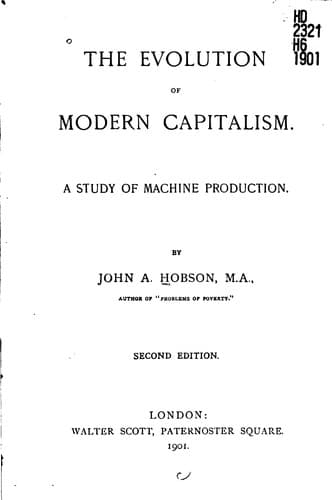
The Evolution of Modern Capitalism: A Study of Machine ProductionHobson, J. A. (John Atkinson)
History
The Evolution of Modern Capitalism: A Study of Machine Production
Hobson, J. A. (John Atkinson)
Capitalism; Industries -- History; Machinery in the workplace
Turning to another highly-developed machine industry, that of milling,
we find a similar movement. Flour mills are diminishing in number both
in England and in the United States. The period 1884-86 showed a
diminution in the number of flour mills in the United States from
25,079 to 18,267, though the total productive power of the smaller
number was greatly increased. Mr. Wells finds a similar tendency in
the general manufacturing industry of the United States:--"Between
1850 and 1860 the number of manufacturing firms and corporations in
the United States increased from 123,025 to 140,433, and the value of
manufactured products increased from $1,019,106,616 to $1,885,861,876,
so that in that decade there was an increase of 17,408 establishments,
to an increase of $866,755,060 in the value of products. In 1870 there
were 252,148 firms and corporations so employed, producing
$4,232,325,442 in manufactured products; or an increase of 111,715
establishments in the decade of 1860 to 1870 gave an increase of
$2,346,463,766 in the value of products. In 1880 the number of
manufacturing establishments was returned at 253,852, producing
articles valued at $5,365,579,191, or an addition of only 1704 firms
and corporations was accompanied with an increase of product of
$1,133,537,749. Here then is a demonstration that the average product
of a manufacturing establishment in the United States in 1880 was just
60 per cent. greater than it was in 1860."[103]
§ 2. While the mass of capital and labour which constitutes a business
is growing, the latter grows less rapidly than the former. That is to
say, capital is in point of size becoming more and more the dominant
factor in the business. With the effect of this upon the economic
character and conditions of labour we are not here concerned. The
subject requires a separate treatment. Here it suffices to recognise
the quantitative change that has taken place. Under domestic industry
the value of the implements used was, as a rule, equivalent only to a
few months' wages. In 1845 McCulloch estimated that the fixed capital
in well-appointed cotton mills amounted to about two years' wages of
an operative.[104] In 1890 Professor Marshall assigns a capital in
plant amounting to about £200 or five years' wages for every man,
woman, and child in a fully-equipped spinning mill.[105] In the
typical modern industry, that of cotton-spinning and weaving, the
increasing size is both continuous and rapid. The average number of
spindles and looms to the single factory in 1850 and 1885 are as
follows:--
Spindles. Power-Looms.
1850 10,858 155
1885 15,227 213
Public-domain text, read in full here on John Shaqi.
Reviews
Reviews
No reviews yet
Be the first to share your thoughts on this work.
Elsewhere in the archive
Join the Discussion
Join the discussion
Sign in to leave a comment or review.
Sign InorCreate an account