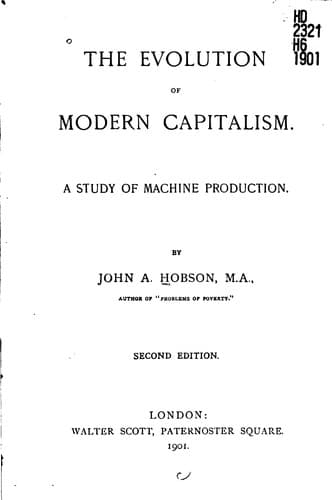
The Evolution of Modern Capitalism: A Study of Machine ProductionHobson, J. A. (John Atkinson)
History
The Evolution of Modern Capitalism: A Study of Machine Production
Hobson, J. A. (John Atkinson)
Capitalism; Industries -- History; Machinery in the workplace
(1) It has a number of trades which are directly co-ordinate--_i.e._,
engaged in the earlier or later processes of producing the same
consumptive goods. Thus the manufacture of shoes is related
co-ordinately to the import trades of hides and bark, to tanning, to
the export trade in shoes, and to the retail shoe trade. A common
stream of produce is flowing through these several processes, and
though from the point of view of ownership and management there may be
no connection, there is a close identity of trade interest and a quick
sympathy of commercial life at these several points.
(2) Each important manufacturing industry has a number of industries
which in their relation to it are secondary, although in some cases,
having similar relations to a number of other trades, they may in
themselves be large and important. In the large textile centres are
found a number of minor industries, planers, sawyers, turners,
fitters, smiths, engaged in irregular work of alteration and repairs
upon the plant and machinery of the textile factories. The same holds
of all important manufactures, especially those which are closely
localised.
A somewhat similar relation appertains between those manufactures
engaged in producing the main body of any product and the minor
industries, which supply some slighter and essentially subsidiary
part. In relation to the main textile and clothing industries, the
manufacture of buttons, of tape, feathers, and other elements of
ornament or trimmings may be regarded as subsidiary. In the same way
the manufacture of wall-papers or house paint may be considered
subsidiary to the building trades, that of blacking to the shoe
manufacture. These subsidiary trades are related to the primary one
more or less closely, and are affected by the condition of the latter
more or less powerfully in proportion as the subsidiary elements they
furnish are more or less indispensable in character. The fur and
feather trades are far more dependent upon direct forces of fashion
than upon any changes of price or character in the main branches of
the clothing trade. On the other hand, any cause which affected
considerably the price of sugar would have a great and direct
influence on the jam manufacture, while the rise in price of tin due
to the M'Kinley tariff caused serious apprehension to the Chicago
manufacturers and exporters of preserved meats.
Public-domain text, read in full here on John Shaqi.
Reviews
Reviews
No reviews yet
Be the first to share your thoughts on this work.
Elsewhere in the archive
Join the Discussion
Join the discussion
Sign in to leave a comment or review.
Sign InorCreate an account