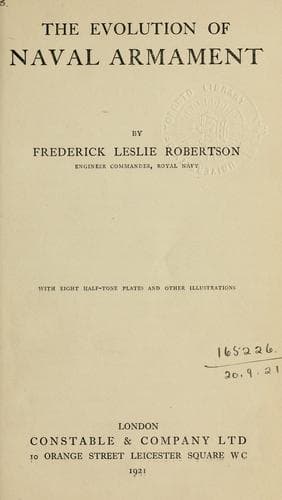
The Evolution of Naval ArmamentRobertson, Frederick Leslie
History
The Evolution of Naval Armament
Robertson, Frederick Leslie
Naval art and science -- History; Ordnance, Naval -- History; Warships -- History
Apart from the inefficiency inherent in the small-ball-and-big-velocity
system the long gun laboured under mechanical disadvantages from which
its squat competitor was happily free. In the eighteenth century the
state of workshop practice was so primitive as to render impossible any
fine measurements of material. Until the time of Whitworth the true
plane surface, the true cylinder and the true sphere were unattainable
in practice. For this reason a considerable clearance had to be
provided between round shot and the bores of the guns for which they
were intended; in other words, the inaccuracies which existed in the
dimensions of guns and shots necessitated the provision of a certain
“windage.” But other considerations had also to be taken into account.
The varying temperatures at which shot might require to be used; the
fouling of gun-bores by burnt powder; the effect of wear and rust on
both shot and bore, and especially the effect of rust on the shot
carried in ships of war (at first enlarged by the rust and then, the
rust flaking or being beaten off with hammers, reduced in size)--all
these factors combined to exact such disproportionate windage that, in
the best conditions, from one-quarter to one-third of the force of the
powder was altogether lost, while, in the worst conditions, as much as
one-half of the propulsive force of the powder escaped unused. Not only
was a large charge required, therefore, but the range and aim of the
loosely fitting shot was often incorrect and incalculable; the motion
of the shot was detrimental to the surface of the bore and the life of
the gun; while the recoil was so boisterous as sometimes to dismount
and disable the gun, injure the crew, and even endanger the vessel.
The inventor of the Smasher, by eliminating this obvious deficiency of
the long gun, gave to his weapon not only a direct advantage due to the
higher efficiency of the powder-charge, but also several collateral
advantages arising from it, such as, economy of powder, ease of recoil,
and small stresses upon the mounting and its supporting structure.
Public-domain text, read in full here on John Shaqi.
Reviews
Reviews
No reviews yet
Be the first to share your thoughts on this work.
Elsewhere in the archive
Join the Discussion
Join the discussion
Sign in to leave a comment or review.
Sign InorCreate an account