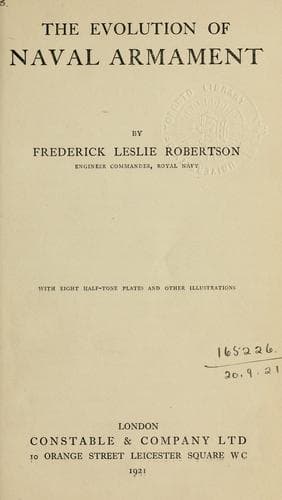
The Evolution of Naval ArmamentRobertson, Frederick Leslie
History
The Evolution of Naval Armament
Robertson, Frederick Leslie
Naval art and science -- History; Ordnance, Naval -- History; Warships -- History
The stream of improvement in naval gunnery began to flow strongly under
the administration of Lord Anson. New methods of firing, experiments
with priming tubes to replace the primitive powder horns and trains
of vent powder, and gun locks to replace the dangerous and unreliable
slow match and linstock,[96] were under trial in the fleets commanded
by Admiral Hawke, but with results not altogether satisfactory.
The locks supplied were lacking in mechanical precision, and the
tubes--“very pernicious things” they were voted--were apt to fly out
and wound the men. But that the unsatisfactory results obtained were
not due to defects inherent in the new devices was soon clearly proved.
Twenty years later an eminent gunnery officer, Sir Charles Douglas,
by perseverance and an enthusiastic attention to mechanical detail,
succeeded in making both locks and priming tubes a practical success,
greatly enhancing by their aid the rate and effectiveness of fire of
the great guns. Flint-locks of his own design he bought and fitted
to the guns of his ship at his private expense. Flannel-bottomed
cartridges, to replace the parchment-covered cartridges which had
caused so much fouling, and goose-quill priming tubes, were provided
by him, and to him is certainly due the credit for initiating the
series of improvements in material which, trivial as they may seem in
detail, yet in the aggregate had the effect of placing our gunnery at a
relatively high level in the ensuing wars.
In addition to introducing improvements in methods of firing, Sir
Charles Douglas did much to improve the efficiency of the truck
carriages themselves. On his appointment to the _Duke_ in 1779 he at
once began to put his schemes in hand. To ease the recoil of the guns
and to save their breechings he devised and fitted steel springs in
some way to the latter; with such surprising good effect (he reported)
that even with a restricted length of recoil no breeching, not even
that of a 32-pounder weather gun double-shotted and fired over a
slippery deck, was ever known to break. The recoil he further eased by
loading the truck carriage with shot, which he slung on it, thereby
augmenting the recoiling mass. He also proposed and tried another
apparatus having the same effect: suspended weights, secured to the
carriage by ropes reeved through fairleads, which on recoil the gun was
made to lift. Which weights also had an effect in helping to run the
gun out again which he calculated to be equal to that of two extra men
on the tackles.
Public-domain text, read in full here on John Shaqi.
Reviews
Reviews
No reviews yet
Be the first to share your thoughts on this work.
Elsewhere in the archive
Join the Discussion
Join the discussion
Sign in to leave a comment or review.
Sign InorCreate an account