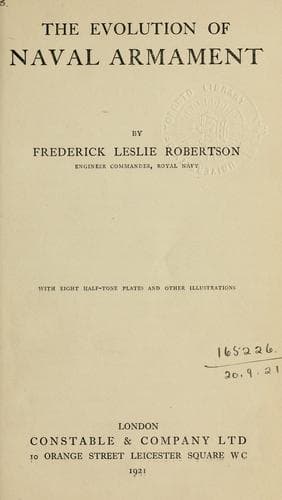
The Evolution of Naval ArmamentRobertson, Frederick Leslie
History
The Evolution of Naval Armament
Robertson, Frederick Leslie
Naval art and science -- History; Ordnance, Naval -- History; Warships -- History
Through all the subsequent changes of armament up to the Crimean War,
from solid shot to shell-fire, the truck carriage maintained its place
of favour. In 1811 Colonel (afterwards Sir William) Congreve had
published a treatise demonstrating the defects of the truck carriage
and proposing in its place a far more scientific and ingenious form of
mounting. It lacked, however, some of the characteristics which, as we
have seen, gave value to the old truck carriage. Except where special
conditions gave additional value to its rival, the truck carriage
kept its place. In 1820 an iron carriage was tried officially, for
24-pounders, but gave unsatisfactory results. In 1829 the Marshall
carriage was tried, offering important advantages over the standard
pattern. Its main feature was a narrow fore-carriage separate from the
recoiling rear portion, this fore-carriage being pivoted to a socket in
the centre of the gun-port. But still the truck carriage survived the
very favourable reports given on its latest rival.
As concentration of fire became developed new fittings such as
directing bars, breast chocks and training racers made their appearance
and were embodied in its design. As the power of guns and the energy
requiring to be absorbed on recoil increased, the rear trucks
disappeared and gave place, in the two-truck Marsilly carriage, to
flat chocks which by the friction of their broad surfaces against the
deck helped more than trucks to deaden the motion of the carriage.
The quoin, perfected by the addition of a graduated scale marked
to show the elevation corresponding to each of its positions, gave
place at length to various mechanical forms of elevating gear. The
elm body was replaced by iron plates bolted and riveted together. And
then at length, with the continuous growth of gun-energy, the forces
of recoil became so great that the ordinary carriage constrained by
rope breechings could no longer cope with them. The friction of wood
rear-chocks against the deck was replaced by the friction of vertical
iron plates, attached to the carriage, against similar plates attached
to a slide interposed between carriage and deck, and automatically
compressed: the invention, it is said, of Admiral Sir Thomas Hardy. The
truck carriage, as it had been known for centuries, had at last been
left behind in the evolution of naval artillery.
* * * * *
Public-domain text, read in full here on John Shaqi.
Reviews
Reviews
No reviews yet
Be the first to share your thoughts on this work.
Elsewhere in the archive
Join the Discussion
Join the discussion
Sign in to leave a comment or review.
Sign InorCreate an account