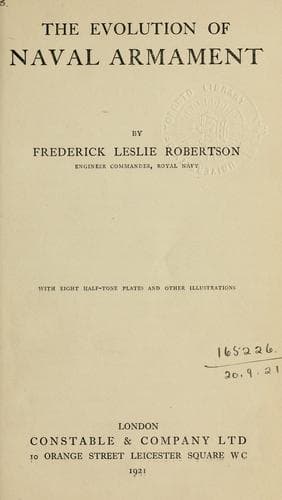
The Evolution of Naval ArmamentRobertson, Frederick Leslie
History
The Evolution of Naval Armament
Robertson, Frederick Leslie
Naval art and science -- History; Ordnance, Naval -- History; Warships -- History
The nation soon obtained value from the new development. The efficiency
of the Enfield rifle at the Alma and at Inkerman was attested by the
correspondent of _The Times_, who reported that “it smote the enemy
like a destroying angel.” Three years later the Indian Mutiny afforded
a still more conclusive proof of the value of this weapon. Though,
from the greased cartridges which were used, it served as one of the
pretexts for the mutiny, it proved in the sequel a powerful military
instrument, and demonstrated both to friend and foe its superiority
over the smooth-bore musket with which the rebels were armed. In
fact, with the adoption of the Enfield rifle, England found herself
in advance even of France; the French, partly perhaps from motives
of economy, partly from a desire for symmetry, had retained in their
Minié rifle the same calibre as that of their old smooth-bore: indeed,
the greater part of the French army rifles were merely converted
smooth-bores. In the Enfield a wise reduction of calibre had been
made; whereby, while the weight of the rifle was reduced, its strength
and the size of the permissible charges, and therefore the range and
penetrating power of the projectile were all considerably augmented.
Having once gained the lead, England now took another rapid move
forward in the development of the rifle. Though the new standards set
by the Enfield were high, expert opinion aimed at something still
higher; the Enfield gave variations in range and direction which could
not be accounted for by errors in manufacture, nor did the range and
penetrative power of the bullet come up to expectations. In these
circumstances the government sought the advice of a man whose name was
destined to loom large in the story of the subsequent development of
ordnance: Mr. Whitworth. Mr. Whitworth was described as the greatest
mechanical genius in Europe at that time. Certain it is that, although
in the realm of ordnance his name may have been overshadowed to a
certain extent by that of his great rival, yet on the broad ground of
the influence his inventions exerted on the progress of mechanical
science generally, his fame now grows with time. He it was who first
swept away the medieval conception of measurement which hitherto had
obtained in factories and workshops, and introduced a scientific
precision into the manufacture of machines and mechanisms. The true
plane surface, as we know it to-day, was unattained before his time;
and his contemporaries marvelled at plates of metal prepared by him of
so true a surface that, by their mere adhesion, one could be lifted by
means of the other. The micrometer was a similar revelation. Men whose
minimum of size had hitherto been the thickness of a chalk-line or a
simple fraction of an inch, were taught by him to measure the inch
to its ten-thousandth part, and even to gauge the expansion of a rod
caused by the warmth imparted by the contact of a finger.
Public-domain text, read in full here on John Shaqi.
Reviews
Reviews
No reviews yet
Be the first to share your thoughts on this work.
Elsewhere in the archive
Join the Discussion
Join the discussion
Sign in to leave a comment or review.
Sign InorCreate an account