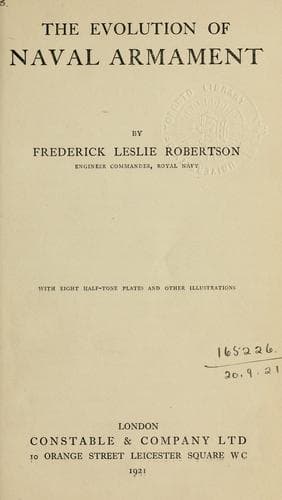
The Evolution of Naval ArmamentRobertson, Frederick Leslie
History
The Evolution of Naval Armament
Robertson, Frederick Leslie
Naval art and science -- History; Ordnance, Naval -- History; Warships -- History
In England, too, an independent development was at the same time taking
place in yet another direction. Mr. Whitworth, having satisfactorily
established the principles governing the design of rifles, felt
confident of extending them to field and heavy ordnance. Adhering to
the muzzle-loading principle and to his hexagonal form of rifling he
manufactured, between the years 1854 and 1857, several guns which
fired projectiles of from six to twenty-four pounds’ weight with
great accuracy and to ranges greater than any yet attained. Events
occurred which caused him to be given every encouragement by the
government. The attitude of the French in these years was suspicious
and unfriendly. Schemes of invasion were openly discussed in their
press, and war vessels of various types equipped with armour plate
were designed and actually built. Reports of their plans, following
closely on the exposures of the Crimean War and the Indian Mutiny,
rendered the country increasingly restless and apprehensive as to the
value of our offensive and defensive armaments. And then, although the
new Armstrong gun was acclaimed as eminently suited for service in the
field, doubts had been cast as to whether the principles of its design
could be applied satisfactorily to the heaviest ordnance. Other rifled
artillery had certainly failed to give the results expected from it.
The Lancaster rifled gun, a muzzle-loading gun with a twisted bore of
a slightly oval section, had failed lamentably at the Crimea owing
to the tendency, according to one account, of the oval projectile to
wedge itself against the slightly larger oval of the bore; according to
another account, owing to the flames from the powder gases penetrating
the interior of the welded shells which had been supplied for it. The
breech-loading ordnance of Cavalli had failed the Italians. In Sweden
several accidents had occurred with Wahrendorf’s breech-loading pieces.
The French system, which had been copied by the majority of the powers,
was that which appeared to be giving the least unsatisfactory results.
In these circumstances every encouragement was given Mr. Whitworth to
develop ordnance on his own lines. In ’58 a committee on rifled guns
was appointed by parliament to examine and report on the relative
merits of the various systems in use. The committee quickly set to
work. No difficulty was found in eliminating all but two, on which
attention was soon concentrated: the Armstrong and the Whitworth.
The result of the final investigation was a report in favour of the
Armstrong gun, which, as we have already seen, was adopted in the same
year for field service. Mr. Armstrong, who had handed over his rights
in the gun for the benefit of the nation, was knighted and his services
were subsidized for the improvement of rifled ordnance generally. The
title of “Engineer to the War Department” was conferred on him, and
later he received the further appointment of “Superintendent of the
Royal Gun Factory” at Woolwich.
Public-domain text, read in full here on John Shaqi.
Reviews
Reviews
No reviews yet
Be the first to share your thoughts on this work.
Elsewhere in the archive
Join the Discussion
Join the discussion
Sign in to leave a comment or review.
Sign InorCreate an account