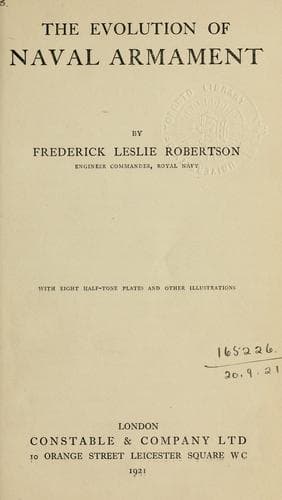
The Evolution of Naval ArmamentRobertson, Frederick Leslie
History
The Evolution of Naval Armament
Robertson, Frederick Leslie
Naval art and science -- History; Ordnance, Naval -- History; Warships -- History
So a return to the breech-loading ordnance became inevitable, and the
change was made. The old Armstrong moveable vent-piece was avoided,
however, in the new designs; of the two alternative breech-closing
systems in use, viz. the wedge system of Krupp and the “interrupted
screw” system of the French, the latter was adopted. A steel tube,
rifled on the polygroove system, formed the body of the piece, and this
was strengthened by hoops of iron or steel shrunk on its exterior. The
new gun yielded a very great increase of power. Muzzle-loading guns
were at once displaced, in the projected programme of new battleships,
for the new type of ordnance, and a further series of revolutionary
changes in ship armament at once took place. Other nations had already
augmented the length and power of their guns. By the adoption of the
improved breech-loading ordnance, Great Britain, who for the last few
years had been falling behind her rivals, not only drew level with them
but definitely took the lead in the power of her heavy ordnance: a lead
which from that time to this she has successfully maintained.
CHAPTER IX
PROPELLING MACHINERY
No aspect of old naval warfare is so difficult for the modern reader
to visualize, perhaps, as that which displays the essential weakness
of the sailing warship: its impotence in a calm. It was a creature
requiring for its activities two elements, air and water. Ruffle the
sea with a breeze, and the sailing ship had power of motion towards
most of the points of the compass; withdraw the winds, and she lay
glued to the smooth water or rolling dangerously in the heavy swell,
without power either of turning or translation. For centuries this
weakness told heavily against her and in favour of the oar-propelled
vessel, particularly in certain latitudes. Through many years, indeed,
the two types held ascendancy each in its own waters; in the smooth
stretches of the Mediterranean the oar-driven galley, light, swift,
and using its sharp ram or bow-cannon as chief means of offence or
defence, was a deadly danger to the becalmed sailing ship; in the
rougher north Atlantic the sailing ship, strong, heavy, capacious,
and armed for attack and defence only along its sides, proved far
too fast and powerful for the oar-driven rival. Progress--increase
of size, improvement in artillery, the development of the science of
navigation--favoured the sailing ship, so that there came at last the
day when, even in the Mediterranean, she attained ascendancy over the
galley. But always there was this inherent weakness: in a dead calm
the sailing ship lay open to attack from a quarter where her defence
lay bare. Ninety-nine times out of a hundred, perhaps, she could move
sufficiently to beat off her attacker by bringing her broadsides
to bear. The hundredth, she lay at the mercy of her adversary, who
could, by choosing his range and quarter of attack, make her temporary
inferiority the occasion of defeat. For this military reason many
Public-domain text, read in full here on John Shaqi.
Reviews
Reviews
No reviews yet
Be the first to share your thoughts on this work.
Elsewhere in the archive
Join the Discussion
Join the discussion
Sign in to leave a comment or review.
Sign InorCreate an account