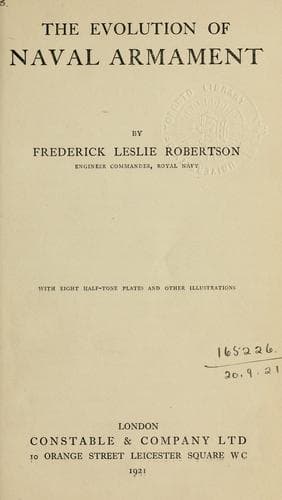
The Evolution of Naval ArmamentRobertson, Frederick Leslie
History
The Evolution of Naval Armament
Robertson, Frederick Leslie
Naval art and science -- History; Ordnance, Naval -- History; Warships -- History
In Bourne’s _Inventions and Devices_, published in 1578, is the first
mention of paddlewheels (so far as we know) in any English book. By
the placing of certain wheels on the outside of the boat, he says, and
“so turning the wheels by some provision,” the boat may be made to go.
And then he proceeds to mention the inversion of the paddlewheel, or
the paddlewheel which is driven, as distinguished from the paddlewheel
which drives. “They make a watermill in a boat, for when that it rideth
at an anker, the tide or stream will turn the wheels with great force,
and these mills are used in France,” etc. It is possible, indeed, that
this was the prior form, and that the earliest paddlewheel was a mill
and not primarily a means of propelling the vessel.
Early in the seventeenth century the mechanical sciences began to
develop rapidly and as the century advanced the flood of patents for
the propulsion of ships increased. “To make boats, ships, and barges
to go against the wind and tide”; “the drawing and working of barges
and other vessels without the use of horses”; “for making vessels to
navigate in a straight line with all winds though contrary”; these
are some of the patents granted, the details of which are not known.
At last the ingenious Marquis of Worcester, who in 1663 was granted a
patent for his steam engine, also obtained a patent for an invention
for propelling a vessel against wind and stream. It has sometimes been
inferred that this invention was connected in some way with the steam
engine, and the claim has been made that the Marquis was one of the
first authors of steam propulsion. This is not so. Contained in the
description of the ship-propelling invention are two statements which
dispose completely of the theory that steam was the motive force;
first, that the “force of the wind or stream causeth its (the engine’s)
motion”; secondly, that “the more rapid the stream, the faster it (the
vessel) advances against it.” From this it appears that the Marquis
intended to utilize the watermill as described by Bourne. From a study
of the description of the apparatus it has been concluded that “a
rope fastened at one end up the stream, and at the other to the axis
of waterwheels lying across the boat, and dipping into the water so
as to be turned by the wheels, would fulfil the conditions proposed
of advancing the boat faster, the more rapid the stream; and when at
anchor such wheels might have been applied to other purposes.”[133] If
this reconstruction is correct, the scope of the propelling device was
very limited.
Public-domain text, read in full here on John Shaqi.
Reviews
Reviews
No reviews yet
Be the first to share your thoughts on this work.
Elsewhere in the archive
Join the Discussion
Join the discussion
Sign in to leave a comment or review.
Sign InorCreate an account