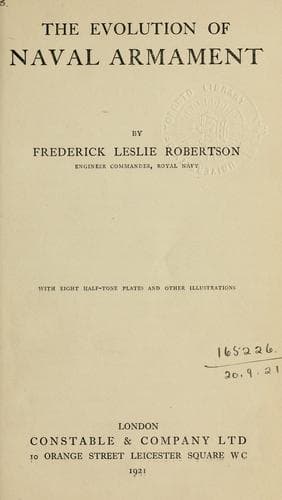
The Evolution of Naval ArmamentRobertson, Frederick Leslie
History
The Evolution of Naval Armament
Robertson, Frederick Leslie
Naval art and science -- History; Ordnance, Naval -- History; Warships -- History
In Britain a successful attempt to apply the steam engine to the
paddlewheel was made in 1788. In that year three men, combining
initiative, financial resource, and a large measure of engineering
ingenuity, proved the possibility of steam propulsion in an experiment
singularly complete and of singularly little effect on subsequent
progress. In the summer of ’87 a wealthy and inventive banker, Mr.
Patrick Miller of Dalswinton, Edinburgh, had been making experiments
in the Firth of Forth with a double vessel of his own invention, sixty
feet long, which, when wind failed for sailing, was set in motion by
two paddlewheels. These paddlewheels were fitted between the two hulls
of the vessel and were worked by men, by means of a geared capstan.
Miller believed that a boat furnished with paddlewheels and worked
manually would be of great advantage for working in shallow rivers
and canals. But the result of a sailing race between his boat and a
custom-house wherry of Leith, in which his own sails were supplemented
by the labours of four men at the wheels, convinced him that manpower
was insufficient. His sons’ tutor, a Mr. Taylor, suggested the
application of a steam engine. And being acquainted with an engineer
named Symington, Taylor prevailed on his patron to engage him to mount
a one-horse-power engine in a double pleasure boat, upon the lake
at Dalswinton. The experiment was a complete success. “The vessel
moved delightfully, and notwithstanding the smallness of the cylinder
(4 inches diameter), at the rate of 5 miles an hour. After amusing
ourselves a few days the engine was removed and carried into the house,
where it remained as a piece of ornamental furniture for a number of
years.”[137] Determined to pursue the experiment, Miller ordered a
replica of the original engine on a larger scale, and this engine, with
a cylinder of 18 inches diameter, was erected at Carron and fitted to
a larger boat. This also was successful. But no further trials were
made after ’89; for Patrick Miller, who had spent a large sum in order
to establish the feasibility of the invention, decided to close his
investigations, and to turn to other pursuits.
Public-domain text, read in full here on John Shaqi.
Reviews
Reviews
No reviews yet
Be the first to share your thoughts on this work.
Elsewhere in the archive
Join the Discussion
Join the discussion
Sign in to leave a comment or review.
Sign InorCreate an account