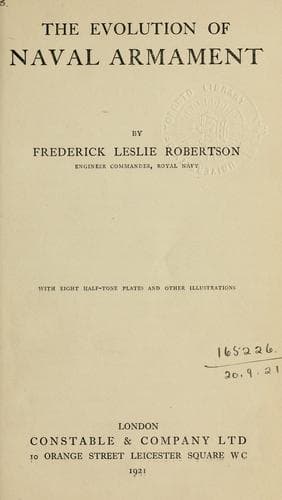
The Evolution of Naval ArmamentRobertson, Frederick Leslie
History
The Evolution of Naval Armament
Robertson, Frederick Leslie
Naval art and science -- History; Ordnance, Naval -- History; Warships -- History
An individual of extraordinary qualities had now turned his attention
to the problem of steam propulsion. In that same year a young American
artist, Robert Fulton, who had come to England to work under the
guidance of his countryman Benjamin West, wrote to Lord Stanhope
informing him of a plan which he had formed for moving ships by steam.
Lord Stanhope, well known as a scientific inventor, had recently been
experimenting with a vessel fitted with a 12-horse-power engine of
Boulton and Watt’s working a propeller which operated like the foot of
an aquatic bird. A correspondence ensued. Fulton, whose self-confidence
equalled his originality, illustrated by drawings and diagrams his
ideas on the subject. At first, he said, he thought of applying the
force of an engine to an oar or paddle which, hinged on the counter
at the stern, by a reciprocating motion would urge the vessel ahead.
But on experimenting with a clockwork model he found that, though the
boat sprang forward, the return stroke of the paddle interfered with
the continuity of the motion. “I then endeavoured,” he wrote, “to give
it a circular motion, which I effected by applying two paddles on an
axis. Then the boat moved by jerks; there was too great a space between
the strokes. I then applied three paddles, forming an equilateral
triangle to which I gave a circular motion.” These paddles he proposed
to place in cast-iron wheels one on each side of the boat and mounted
on the same shaft at some height over the waterline, so that each wheel
would “answer as a fly and brace to the perpendicular oars.” And he
stated that he found, from his experiments with models, that three or
six oars gave better results than any other number. From which it is
clear that the paddlewheel was evolved by Fulton from the simple paddle
independently of suggestion received from previous inventors.
Public-domain text, read in full here on John Shaqi.
Reviews
Reviews
No reviews yet
Be the first to share your thoughts on this work.
Elsewhere in the archive
Join the Discussion
Join the discussion
Sign in to leave a comment or review.
Sign InorCreate an account