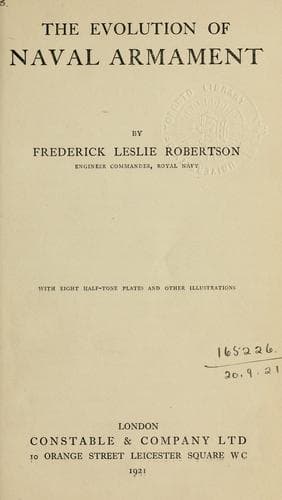
The Evolution of Naval ArmamentRobertson, Frederick Leslie
History
The Evolution of Naval Armament
Robertson, Frederick Leslie
Naval art and science -- History; Ordnance, Naval -- History; Warships -- History
Armed with this knowledge, with all the experience of Rumsey and Fitch,
and with the data from his own trials, Fulton brought to a successful
solution the problem of steam propulsion on a commercial scale. It
has been remarked that there was no element in the _Clermont_ or her
successors so original in conception that it would entitle Fulton to
be regarded as the inventor of steam navigation. Nor did he himself
claim to be such. He was successful in fitting together the elements,
the inventions of others. Science is measurement, and Fulton applied
his data and measured with great insight, adapting his elements in the
right manner and proportion to form an efficient whole. “He was the
first to treat the elementary factors in steamship design--dimensions,
form, horse-power, speed, etc.--in a scientific spirit; to him belongs
the credit of having coupled the boat and engine as a working unit.”
From Fitch he had learned the economy of size, and the advantages of
enlarging the scale of operations; from Beaufoy, the importance of a
fair underwater form, with a sharp bow and stern. From Symington, who
generously took him for a trip in the _Charlotte Dundas_, he could
not fail to have gleaned much practical advice and information; it is
remarkable, in this connection, that, after a sight of Symington’s
horizontal cylinder with its simple connecting-rod drive to the
stern wheel, he should have adhered to the vertical cylinder and the
bell-crank or beam for the transmission of the force: an initial
divergence which was perpetuated, and which became the hall-mark
distinguishing American from English practice for some years to come.
Most of his knowledge he gained by his activities in England, and many
writers have contested a claim--which so far as is known was never
made by him--to the invention of the steamship. His achievements were
well defined and legitimately executed, and the remarkable insight and
initiative which he displayed in adapting the labours of others to
serve his own utilitarian ends cannot, surely, deserve the opprobrium
cast on them by some of the nineteenth-century writers. Prometheus,
it is said, stole fire from heaven. Fulton bought his in the open
market; obtaining his engine in Soho and his boiler in Smithfield
he transported them across the Atlantic, and in 1807 produced the
_Clermont_.
Public-domain text, read in full here on John Shaqi.
Reviews
Reviews
No reviews yet
Be the first to share your thoughts on this work.
Elsewhere in the archive
Join the Discussion
Join the discussion
Sign in to leave a comment or review.
Sign InorCreate an account