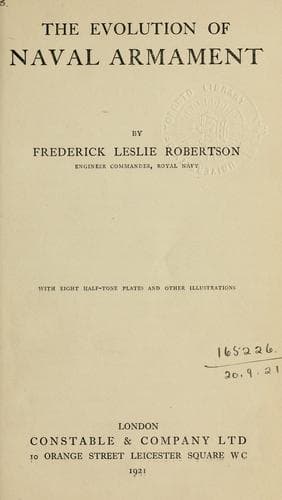
The Evolution of Naval ArmamentRobertson, Frederick Leslie
History
The Evolution of Naval Armament
Robertson, Frederick Leslie
Naval art and science -- History; Ordnance, Naval -- History; Warships -- History
to preserve order. She steamed into harbour, with wind and tide, at
from twelve to fourteen knots. A court-martial was sitting in the
_Gladiator_ frigate, but the whole court except the president adjourned
to inspect the strange visitor. Next day the port admiral sent off a
guard and band; and soon afterwards he followed, accompanied by three
admirals, eighteen post captains, and a large number of ladies.[142]
The success of the _Thames_ led to the immediate building of other
and larger steamers. In ’17 the son of James Watt purchased a 94-foot
boat, the _Caledonia_, fitted her with 28-horse-power machinery
driving 10-foot paddlewheels, and for a pleasure trip proceeded in
her up the Rhine as far as Coblentz. From this time onwards steam
navigation for commercial purposes progressed rapidly. In 1818 a
steamboat made regular voyages at sea; the _Rob Roy_, 90 tons, built
by Denny of Dumbarton, with engines of 30 horse-power made by Napier,
plied regularly between Holyhead and Dublin. In the same year the
_Savannah_, a ship of 350 tons’ burden built and fitted with auxiliary
steam machinery at New York, crossed the Atlantic, partly under steam;
her paddlewheels with their cast-iron frame and axletree successfully
withstanding heavy weather. In ’21 the postmaster-general introduced a
steam service for the mails at Dover and Holyhead; and in the following
year there were steamboats running between London and Leith, and other
seaports. The experience of the Holyhead packets was of special value,
as it proved that steam vessels could go to sea in weather which would
keep sailing vessels in harbour. Soon after this the question was
raised of employing steam power to shorten the passage between England
and the East, as well as of the navigation by steam of the great
Indian rivers. Steam superseded sails in the government mail service
between Falmouth, Malta and Corfu; everywhere commercial enterprise
was planning new lines of steamships and new possibilities of ocean
travel. In ’25 a barque belonging to Mr. Pelham, afterwards Earl of
Yarborough, was fitted with steam machinery as an auxiliary and made
the voyage to India. The plash of the paddlewheel was then heard for
the first time in Oriental waters.
By this time the great question of steam as applied to naval ends had
arrived to agitate the Admiralty.
Public-domain text, read in full here on John Shaqi.
Reviews
Reviews
No reviews yet
Be the first to share your thoughts on this work.
Elsewhere in the archive
Join the Discussion
Join the discussion
Sign in to leave a comment or review.
Sign InorCreate an account