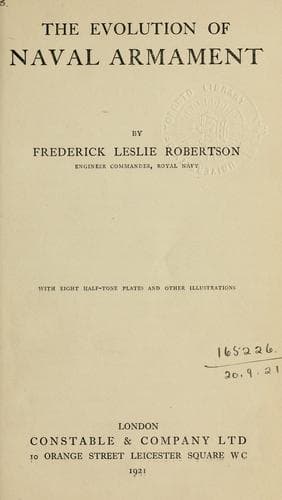
The Evolution of Naval ArmamentRobertson, Frederick Leslie
History
The Evolution of Naval Armament
Robertson, Frederick Leslie
Naval art and science -- History; Ordnance, Naval -- History; Warships -- History
lengthened bow and a well-tapered run: an improved form of body by
the use of which high speeds were obtained. In the case of commercial
steamships the advantages of fine lines had already been recognized,
and their designers had been free to give them a form which would allow
of a high speed being attained; but in the case of war vessels designed
to carry a broadside armament the limitations imposed by the heavily
weighted ends had hitherto prevented other than bluff bows and sterns
being given them. But now the subject of ship form came under general
consideration, and the new conditions led to a more serious study of
the laws governing the motion of bodies through water.
Year after year the size of steamers grew.[150] And as with size the
cost of construction and maintenance increased, the question pressed
itself more and more clearly--what was the naval utility of such
expensive and lightly armed vessels? Numerous attempts were made to
produce a form of paddlewheel steamer which would carry a broadside
armament comparable with that which a sailing vessel of the same
burthen would bear. In 1843 the _Penelope_, 46 guns, was cut in
halves at Chatham and lengthened by the addition of about 65 feet, in
which space engines of 650 horse-power were installed. But the extra
displacement failed to compensate for the weight of the machinery;
the altered vessel drew more water than had been anticipated and,
though various alterations were made to minimize the effects of this,
the experiment was not a success and was not repeated. In ’45 a steam
frigate called the _Odin_ was built by order of the Board. “The results
aimed at in constructing this ship were--capability of carrying
broadside armament; diminished rolling, in comparison with any war
steamers then built; and less draught of water in relation to the size.
These objects were accomplished; but as the position of the machinery
and boilers is partially above the water-line, and the propellers
are exposed to danger in broadside fighting, the ship is necessarily
imperfect in these two conditions, as well as in the position of the
sails; for in this case the proper place of the mainmast was occupied
by the boilers, and consequently the centre of effort of the wind on
the sails is in a wrong place.”[151] In the same year the _Sidon_ was
laid down, the design being on the lines of the _Odin_ but modified in
accordance with the ideas of Sir Charles Napier: with greater depth of
hold and with machinery below the water-line. Iron tanks were placed in
the hold for carrying the coals; by filling these with water when empty
the steamer was kept at a more or less constant draught, a matter of
considerable importance to the efficient working of the paddlewheels.
In other respects, however, the _Sidon_ was unsatisfactory. She was so
crank that the addition of ballast and a modification of her armament
were necessary. Her engines were cramped, her boilers of insufficient
Public-domain text, read in full here on John Shaqi.
Reviews
Reviews
No reviews yet
Be the first to share your thoughts on this work.
Elsewhere in the archive
Join the Discussion
Join the discussion
Sign in to leave a comment or review.
Sign InorCreate an account