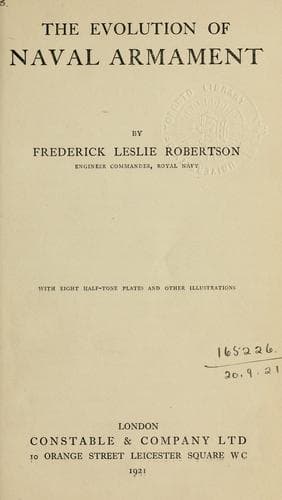
The Evolution of Naval ArmamentRobertson, Frederick Leslie
History
The Evolution of Naval Armament
Robertson, Frederick Leslie
Naval art and science -- History; Ordnance, Naval -- History; Warships -- History
The evolution of artillery falsified these expectations. With the
growing advantage of artillery over the defence, and with the coming of
the torpedo, fighting ranges increased and the use of the ram declined.
With greater speeds and greater ranges the possibility of ramming
became (as might be deduced mathematically) a diminishing ratio; before
the end of the century it was sufficiently clear, and was confirmed by
actual warfare, that the ram formed but a very secondary factor of a
warship’s offensive power. But for some years ramming, and “bows-on”
fighting in which ramming was intended to play an important part,
influenced to a great extent the designs of warships.
So much for the ram, first fitted in the _Warrior_. In her sister
ship the ram was less pronounced and, before Hampton Roads had drawn
attention to its possibilities, it was even in question to renounce
it altogether. In the case of the _Warrior_ the heavy figure-head
so overhung the ram that many were dubious whether the latter would
seriously damage an enemy; and, moreover, the wisdom of driving a fully
rigged ship against another vessel, and risking the dismantling of
her masts and rigging, was widely doubted. In other respects, except
for her armour belt and for the material of which she was built, that
vessel was not radically different from her predecessors; the first of
iron-built ironclads was a handsome screw frigate not unlike previous
British ships of her type, from whom she was lineally descended.
Although on the whole she was a conspicuous success, it was soon
apparent that the great length of the _Warrior_ tended to make her
difficult to manœuvre: in fact, made her deficient in that very
quality--handiness--which was indispensable to her effective use as
a ram. And this unhandiness was accentuated in the _Minotaur_ class
which was begun in 1861. These ships were given a belt an inch thicker
than that of the _Warrior_, and, partial protection being considered
objectionable, especially as leaving exposed the steering gear and a
portion of the gun armament, the belt was made continuous over the
whole length of the ship. This length, owing to the extra weight of
the armour, was 400 feet: 20 feet greater than that of the _Warrior_
and a hundred greater than that of the longest timber-built ships. At
first, five masts were fitted, in order to obtain a large sail-area
while at the same time keeping the size of each sail within desirable
limits; but these were afterwards reduced to three. Sail power and
steam machinery were seen to be an imperfect combination in so large
a vessel. The _Minotaur_ class proved to be costly, unhandy and
vulnerable ships, and signalled a return to smaller dimensions. It was
found possible to design ships equally fast and equally well armed and
protected, by the use of fuller lines and less length and an increased
engine power. “Increased manœuvring power and reduction in prime cost,”
Public-domain text, read in full here on John Shaqi.
Reviews
Reviews
No reviews yet
Be the first to share your thoughts on this work.
Elsewhere in the archive
Join the Discussion
Join the discussion
Sign in to leave a comment or review.
Sign InorCreate an account