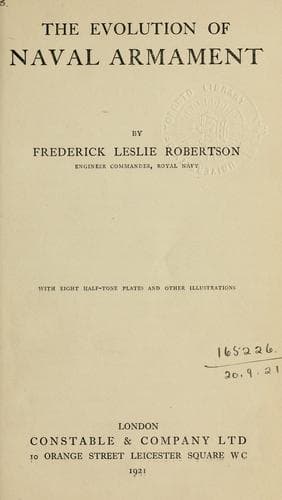
The Evolution of Naval ArmamentRobertson, Frederick Leslie
History
The Evolution of Naval Armament
Robertson, Frederick Leslie
Naval art and science -- History; Ordnance, Naval -- History; Warships -- History
Even in the _Captain_ ahead fire was not found possible. In the
original plans she had the low freeboard favoured by her designer;
but in the later plans poops and forecastles were added to give the
necessary sea-going qualities, and ahead fire was thereby sacrificed.
Complete mastage was given her: iron masts in the form of tripods
to avoid the use of shrouds and to give as clear an arc of fire as
possible. The rigging was all stopped short at, and worked from, a
narrow flying deck which was built above the turrets. This flying deck
provided a working space for the crew, who in a moderately rough sea
would not be able to make use of the low upper deck.
[Illustration: THE _MONARCH_
From a photograph by Symonds, Portsmouth]
On the night of September 6th, 1870, the _Captain_ capsized in a heavy
sea off C. Finisterre. In St. Paul’s Cathedral the memorial brass,
erected in commemoration of this disaster, records that the _Captain_
was built in deference to public opinion expressed in parliament and
through other channels, and in opposition to the views and opinions of
the Controller and his department; and that the evidence all tended to
show that they generally disapproved of her construction.
§
The difficulty of combining the turret system with a full rig of masts
and sails had for a long time been recognized. Some eighteen months
before the loss of the _Captain_, the Admiralty, in the presence of the
increasing efficiency of steam machinery, had decided to construct a
mastless sea-going turret ship.
American experience greatly influenced this decision. In America, where
the principle of machinery for propulsion and for working the guns had
been accepted with a greater readiness than in Europe, the line of
development had been more direct. From the original _Monitor_ a whole
series of derivatives had been produced, and from coast-defence vessels
of a single turret advance had been made to ocean-going mastless
turret ships of low freeboard, carrying the largest smooth-bore guns.
These ocean monitors, lacking though they did some features which were
considered indispensable in British warships, yet exerted an undoubted
influence upon our own construction. Weakly designed in many respects,
with small fuel capacity, and unsteady as gun platforms, they were
regarded by some writers as the true progenitors of the class of
warship which now superseded the masted vessels of the ’sixties.
Public-domain text, read in full here on John Shaqi.
Reviews
Reviews
No reviews yet
Be the first to share your thoughts on this work.
Elsewhere in the archive
Join the Discussion
Join the discussion
Sign in to leave a comment or review.
Sign InorCreate an account