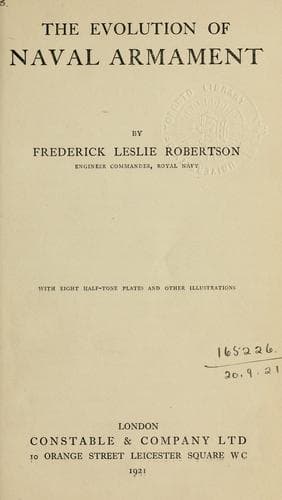
The Evolution of Naval ArmamentRobertson, Frederick Leslie
History
The Evolution of Naval Armament
Robertson, Frederick Leslie
Naval art and science -- History; Ordnance, Naval -- History; Warships -- History
The effect of both statements was to cause widespread anxiety in the
public mind, and a lamentable loss of confidence in the projected
warship. A decision was therefore made to appoint another Committee, of
unquestioned eminence and freedom from bias, to investigate and report
on the _Inflexible_ design. In due course the Committee reported. They
confirmed in a long statement the Admiralty point of view that the
complete penetration and water-logging of the unarmoured ends of the
ship, and the blowing out of the whole of the stores and the cork by
the action of shell fire, was a very highly improbable contingency;
they found that the ship, if reduced to the extremest limit of
instability likely to occur, viz. with her ends completely riddled
and water-logged, but with the stores and cork remaining and adding
buoyancy, would still possess a sufficient reserve both of buoyancy and
of stability; and, balancing the vulnerability of the citadel with its
24-inch armour and the destructibility of the unarmoured ends, they
came to the conclusion that the unarmoured ends were as well able as
the armoured citadel to bear the part assigned to them in encountering
the risks of naval warfare, and that therefore a just balance had been
maintained in the design, so that out of a given set of conditions a
good result had been obtained. Except that a recommendation was made
that the system of cork chambers should be extended, no structural
alteration from the existing design was proposed.
The _Inflexible_ was followed by its smaller derivatives, the _Ajax_
and _Agamemnon_, _Colossus_ and _Edinburgh_, and by the _Conqueror_, an
improved _Rupert_, with a single turret. Movement was in the direction
of smaller displacements and less armour; construction was influenced
at this time more by Italian than by French practice.
§
All through this transitional decade, 1870-80, experience and various
new developments were imperceptibly causing a gradual change of
opinion as to what constituted the best type of battleship. At no
period, perhaps, was the warship more obviously a compromise, at no
time were the limitations of size and weight more keenly felt. So many
considerations interacted with one another, so conflicting were the
claims made of the naval architect, that it appeared indeed almost
impossible to embody them in a satisfactory design. (And yet nothing is
more remarkable than the unanimity with which designers, given certain
conditions, arrived at the same final result: the _Duilio_ and the
_Inflexible_ are a case in point.) Whatever the design might be, it
was open to powerful criticism. And the chief part of this criticism
was directed, as we have seen, against the use and disposition of the
armour.
Public-domain text, read in full here on John Shaqi.
Reviews
Reviews
No reviews yet
Be the first to share your thoughts on this work.
Elsewhere in the archive
Join the Discussion
Join the discussion
Sign in to leave a comment or review.
Sign InorCreate an account