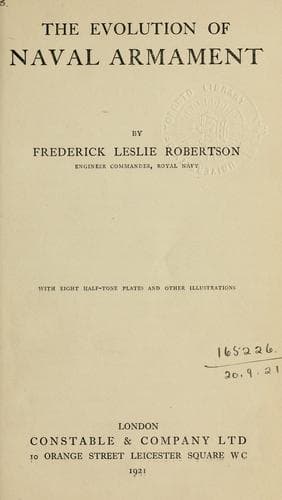
The Evolution of Naval ArmamentRobertson, Frederick Leslie
History
The Evolution of Naval Armament
Robertson, Frederick Leslie
Naval art and science -- History; Ordnance, Naval -- History; Warships -- History
An intimate account of the genesis of the _Collingwood_ design is given
us by the biographer of Sir Cooper Key, to illustrate the manner in
which that prescient administrator succeeded in forecasting the trend
of future construction. In ’66, he says, Captain Key had put on paper a
résumé of his ideas on warship design which was clearly several years
in advance of current opinion. Briefly, he had maintained that the
specifications for our first-class battleships of the future should be
drawn to cover the following features so far as possible:--moderate
speed, small length and great handiness; perfect protection for vital
parts and a complete water-line belt, rather than protection for
personnel and above-water structure; a main-deck armament of broadside
guns of medium calibre amidships, and of lighter calibre towards the
ends, in combination with an upper-deck armament of four large guns
in two unarmoured barbettes, one mounted before the foremast and
one abaft the mizzen-mast; no sails. But for some years no approach
was made to this ideal ship of Captain Key’s; the ideas it embodied
were antagonistic to those held by the great majority of his brother
officers.
“In 1878 there had been laid down by the French, at Toulon, a ship
called the _Caiman_. She was 278 feet long, and had a speed of 14½
knots. She carried a single 42-cm. breech-loading rifled gun at the
bow, and another at the stern, each mounted _en barbette_, and she
further carried on each broadside, between the barbettes, two 10-cm.
guns, besides machine-guns. She was heavily armoured by a water-line
belt 19½ inches thick amidships, and tapering in thickness towards bow
and stern. The middle part of the ship, between the barbettes, was
further protected by a steel deck 2·8 inches thick. Evidently, there
was in this ship some approach to that general ideal which had been
in Sir Cooper Key’s mind in 1866--not, however, more than this. She
gave a sort of hint to the constructors at the Admiralty, and, before
Sir Cooper Key joined the Board, a new design, based indeed on the
_Caiman’s_ hint, but yet differing widely from her, and, by as much as
she differed, approaching more nearly to Sir Cooper Key’s ideal, was in
process of completion there. The ship was the _Collingwood_.”
Public-domain text, read in full here on John Shaqi.
Reviews
Reviews
No reviews yet
Be the first to share your thoughts on this work.
Elsewhere in the archive
Join the Discussion
Join the discussion
Sign in to leave a comment or review.
Sign InorCreate an account