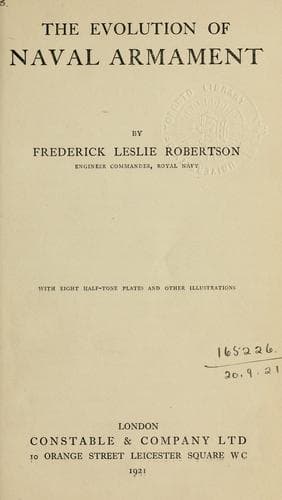
The Evolution of Naval ArmamentRobertson, Frederick Leslie
History
The Evolution of Naval Armament
Robertson, Frederick Leslie
Naval art and science -- History; Ordnance, Naval -- History; Warships -- History
Although this differentiation of types was based ostensibly upon
displacement or tonnage, in reality it was formed on a more scientific
basis. Admiral Sir George Elliot demonstrated, in 1867, that the real
basis was not a rule of size, but a _law of safety_, similar to that
which operates in the natural world; a law so important that it should
under no circumstances be disregarded. He showed that sailing ships
conformed to this law. He showed that the reduction of a vessel’s
size, for instance, endowed her with smaller draught and an increased
speed; that the dispensing with one quality automatically gave another
in compensation; and that thus the weakly armed vessel always possessed
the means, if not to fight, to escape from capture.[173]
With the coming of steam and armour, all this was changed. Size had
now no inherent disability; on the contrary, the larger the ship the
greater the horse-power which could be carried in her, the greater her
probable speed and sea endurance. The small ship had no advantages.
The old classification had clearly broken down. The first ironclads,
the _Warrior_ and her successors, although of frigate form, belonged
to no particular class; they were of a special type intended to cope
with the most powerful ships afloat or projected; and subsequent ships
were designed with the same end in view. These ships being faster as
well as more powerful than those of a smaller size, there was no object
in attempting to build others of a frigate class for the purpose of
outsailing them.
As material developed, and as the warship became more and more
obviously a compromise between conflicting qualities, differentiation
of types was once more seen to be necessary. Attempts were made to
classify on the bases of displacement, material, defensive and motive
power, service, system of armament. In the end British construction
divided itself into two categories: armoured and unarmoured vessels.
And each of these categories was subdivided into classes of ships
analogous to those of the old sailing ships.
Public-domain text, read in full here on John Shaqi.
Reviews
Reviews
No reviews yet
Be the first to share your thoughts on this work.
Elsewhere in the archive
Join the Discussion
Join the discussion
Sign in to leave a comment or review.
Sign InorCreate an account