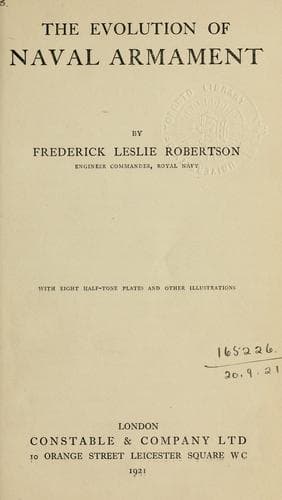
The Evolution of Naval ArmamentRobertson, Frederick Leslie
History
The Evolution of Naval Armament
Robertson, Frederick Leslie
Naval art and science -- History; Ordnance, Naval -- History; Warships -- History
At first England and France had built and appropriated small ironclads
to this secondary service; in France the _Belliqueuse_, in England
the _Pallas_, were designed to this end. But in ’66 the first ship of
the cruiser type was built for the British navy: the _Inconstant_,
of Sir Edward Reed’s design, an iron-built, fine-lined vessel with a
speed of 16 knots and a large coal capacity. She was followed by the
corvettes _Active_ and _Volage_, and then, in ’73, by the _Shah_ and
_Raleigh_. Experience with the early cruisers showed the advantages
of large displacement. “The greater number of the American corvettes
had now been launched. A trial of one of them showed that the high
hopes which had been entertained of their performance were fallacious.
It now appeared no longer necessary that the English corvettes
should possess such extraordinary power and speed, qualities which
necessarily required very large displacements. The Admiralty, however,
still believing in the wisdom of the policy which they had previously
adopted, decided to follow a totally different course from that which
all other navies had been compelled by financial considerations to
follow. So far from diminishing the size of their ships, increased
displacement was given to the new designs.”[174] Full sail power was
still required, for the high-power steam engine used by the cruiser for
fighting purposes was most uneconomical. The _Raleigh_, for instance,
burned her six hundred tons of coal in less than 36 hours, at full
speed.
But after the _Raleigh_ came a slight reaction. With a view to economy
a smaller type of vessel was designed, the smallest possible vessel
which could be contrived which would possess a covered-in gun deck
in combination with other features considered essential in a frigate
class; the result was the _Boadicea_ or the _Bacchante_ class. In the
late ’seventies size again increased, and the _Iris_ and _Mercury_,
unsheathed vessels of steel, with coal-protection for their water-line
and extended watertight subdivision of the hull, were laid down.
From the unarmoured, unprotected cruiser was in time evolved, by the
competition of units, the armoured cruiser. Russia led the way. Her
_General-Admiral_, the first belted cruiser, was built to compete with
the _Raleigh_ and _Boadicea_. Then England designed the _Shannon_,
partially belted and with protective deck and coal protection, to
outmatch her. Eventually the cleavage came, and the cruisers were
themselves divided into two or more classes, in accordance with their
duties, size and fitness for the line of battle.
* * * * *
Public-domain text, read in full here on John Shaqi.
Reviews
Reviews
No reviews yet
Be the first to share your thoughts on this work.
Elsewhere in the archive
Join the Discussion
Join the discussion
Sign in to leave a comment or review.
Sign InorCreate an account