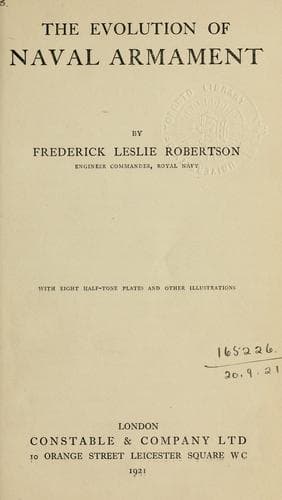
The Evolution of Naval ArmamentRobertson, Frederick Leslie
History
The Evolution of Naval Armament
Robertson, Frederick Leslie
Naval art and science -- History; Ordnance, Naval -- History; Warships -- History
[72] This project, however, is mentioned of an engine called by him “a
semi-omnipotent engine,” the subject of the 98th invention: “an engine
so contrived, that working the _Primum mobile_ forward or backward,
upward or downward, circularly or cornerwise, to and fro, straight,
upright or downright, yet the pretended operation continueth and
advanceth, none of the motions above-mentioned hindering, much less
stopping the other.”
This engine is obviously not the same as that described as the
sixty-eighth invention.
[73] A well-known story, quoted at length in the Memoirs of Sir John
Barrow, connected de Caus with the Marquis of Worcester in dramatic
fashion. The Marquis was being conducted through the prison of the
Bicêtre in Paris when his attention was attracted by the screams of
an old madman who had made a wonderful discovery of the power of
steam, and who had so importuned Cardinal Richelieu that he had been
incarcerated as a nuisance.
“This person,” said the insolvent Lord Worcester after conversing with
him, “is no madman; and in my country, instead of shutting him up, they
would heap riches upon him. In this prison you have buried the greatest
genius of your age.”
The fable, and its exposure by a French writer, M. Figuier, are
described in Dirck’s book.
[74] Millington: _Natural Philosophy_.
[75] Sir E. D. Lawrence: _Steam in Relation to Cornwall_.
[76] Enouf: _Papin, sa vie et son œuvre_.
[77] On the evidence of a picture purporting to represent the first
Newcomen engine, in which mechanisms are shown for operating the cocks
automatically, an attempt has been made to prove that the manipulated
cocks were a figment and the story of Humphrey Potter a myth. The
iconoclast has not been successful. The evidence that the first engines
were hand-controlled is very general (see Galloway’s _Steam Engine and
Its Inventors_).
[78] At this time the corpuscular theory of heat still held the field.
“Caloric,” or the matter of heat, was supposed to be a substance which
could be imparted to or abstracted from a body, which had the property
of augmenting its bulk, but not its weight, by setting its particles at
a greater or less distance from one another.
[79] _Encycl. Brit._, Eleventh Edition.
[80] A text-book published a few years before Robins’ birth (Binnings’
_Light to the Art of Gunnery_, 1689) told how a certain profane and
godless gunner, Cornelius Slime, was carried off by the devil before
the eyes of the astonished onlookers!
[81] Whewell: _Hist. of the Inductive Sciences_.
[82] Dr. Halley: _Phil. Trans._, 1686.
Public-domain text, read in full here on John Shaqi.
Reviews
Reviews
No reviews yet
Be the first to share your thoughts on this work.
Elsewhere in the archive
Join the Discussion
Join the discussion
Sign in to leave a comment or review.
Sign InorCreate an account