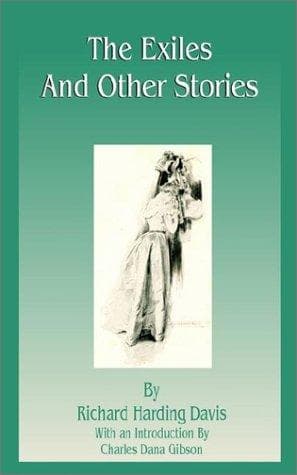
The Exiles and Other StoriesDavis, Richard Harding
General
The Exiles and Other Stories
Davis, Richard Harding
Short stories, American; United States -- Social life and customs -- 19th century -- Fiction
"Come on," he said, "and so Seldon made a hit, did he? I am glad--and
tell me, old man, how long will we have to wait at Gib for the P. & O.?"
Stuart's servant had heard the men trooping down the stairs, laughing
and calling to one another as they went, and judging from this that
they had departed for the night, he put out all the lights in the
library and closed the piano, and lifted the windows to clear the room
of the tobacco-smoke. He did not notice the beautiful photograph
sitting upright in the armchair before the fireplace, and so left it
alone in the deserted library.
The cold night-air swept in through the open window and chilled the
silent room, and the dead coals in the grate dropped one by one into
the fender with a dismal echoing clatter; but the Picture still sat in
the armchair with the same graceful pose and the same lovely
expression, and smiled sweetly at the encircling darkness.
THE REPORTER WHO MADE HIMSELF KING
The Old Time Journalist will tell you that the best reporter is the
one who works his way up. He holds that the only way to start is as a
printer's devil or as an office boy, to learn in time to set type, to
graduate from a compositor into a stenographer, and as a stenographer
take down speeches at public meetings, and so finally grow into a real
reporter, with a fire badge on your left suspender, and a speaking
acquaintance with all the greatest men in the city, not even excepting
Police Captains.
That is the old time journalist's idea of it. That is the way he was
trained, and that is why at the age of sixty he is still a reporter.
If you train up a youth in this way, he will go into reporting with
too full a knowledge of the newspaper business, with no illusions
concerning it, and with no ignorant enthusiasms, but with a keen and
justifiable impression that he is not paid enough for what he does.
And he will only do what he is paid to do.
Now, you cannot pay a good reporter for what he does, because he does
not work for pay. He works for his paper. He gives his time, his
health, his brains, his sleeping hours, and his eating hours, and
sometimes his life, to get news for it. He thinks the sun rises only
that men may have light by which to read it. But if he has been in a
newspaper office from his youth up, he finds out before he becomes a
reporter that this is not so, and loses his real value. He should come
right out of the University where he has been doing "campus notes" for
the college weekly, and be pitchforked out into city work without
knowing whether the Battery is at Harlem or Hunter's Point, and with
the idea that he is a Moulder of Public Opinion and that the Power of
the Press is greater than the Power of Money, and that the few lines
he writes are of more value in the Editor's eyes than is the column of
advertising on the last page, which they are not.
Public-domain text, read in full here on John Shaqi.
Reviews
Reviews
No reviews yet
Be the first to share your thoughts on this work.
Elsewhere in the archive
Join the Discussion
Join the discussion
Sign in to leave a comment or review.
Sign InorCreate an account