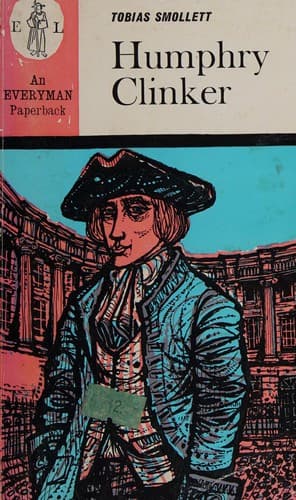
The Expedition of Humphry ClinkerSmollett, T. (Tobias)
General
The Expedition of Humphry Clinker
Smollett, T. (Tobias)
Epistolary fiction; Great Britain -- Fiction; Travelers -- Fiction
A certain winking genius, who wore yellow gloves at dinner, had, on his
first introduction, taken such offence at S--, because he looked
and talked, and ate and drank like any other man, that he spoke
contemptuously of his understanding ever after, and never would repeat
his visit, until he had exhibited the following proof of his caprice.
Wat Wyvil, the poet, having made some unsuccessful advances towards an
intimacy with S--, at last gave him to understand, by a third person,
that he had written a poem in his praise, and a satire against his
person; that if he would admit him to his house, the first should be
immediately sent to press; but that if he persisted in declining his
friendship, he would publish his satire without delay. S-- replied, that
he looked upon Wyvil’s panegyrick, as in effect, a species of infamy,
and would resent it accordingly with a good cudgel; but if he published
the satire, he might deserve his compassion, and had nothing to fear
from his revenge. Wyvil having considered the alternative, resolved to
mortify S-- by printing the panegyrick, for which he received a sound
drubbing. Then he swore the peace against the aggressor, who, in order
to avoid a prosecution at law, admitted him to his good graces. It was
the singularity in S--‘s conduct, on this occasion, that reconciled him
to the yellow-gloved philosopher, who owned he had some genius, and from
that period cultivated his acquaintance.
Curious to know upon what subjects the several talents of my
fellow-guests were employed, I applied to my communicative friend Dick
Ivy, who gave me to understand, that most of them were, or had been,
understrappers, or journeymen, to more creditable authors, for whom they
translated, collated, and compiled, in the business of bookmaking; and
that all of them had, at different times, laboured in the service of
our landlord, though they had now set up for themselves in various
departments of literature. Not only their talents, but also their
nations and dialects were so various, that our conversation resembled
the confusion of tongues at Babel. We had the Irish brogue, the
Scotch accent, and foreign idiom, twanged off by the most discordant
vociferation; for, as they all spoke together, no man had any chance
to be heard, unless he could bawl louder than his fellows. It must be
owned, however, there was nothing pedantic in their discourse; they
carefully avoided all learned disquisitions, and endeavoured to be
facetious; nor did their endeavours always miscarry--some droll repartee
passed, and much laughter was excited; and if any individual lost his
temper so far as to transgress the bounds of decorum, he was effectually
checked by the master of the feast, who exerted a sort of paternal
authority over this irritable tribe.
Public-domain text, read in full here on John Shaqi.
Reviews
Reviews
No reviews yet
Be the first to share your thoughts on this work.
Elsewhere in the archive
Join the Discussion
Join the discussion
Sign in to leave a comment or review.
Sign InorCreate an account