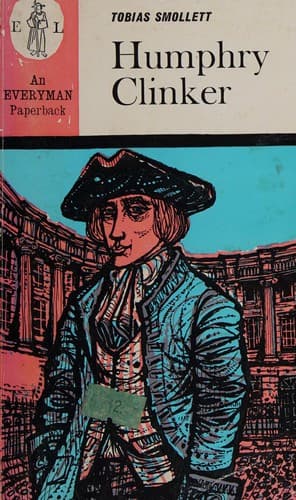
The Expedition of Humphry ClinkerSmollett, T. (Tobias)
General
The Expedition of Humphry Clinker
Smollett, T. (Tobias)
Epistolary fiction; Great Britain -- Fiction; Travelers -- Fiction
When we arrived, there was a family of foreigners at the house, on a
visit to this virtuoso, with whom they had been acquainted at the Spa;
it was the count de Melville, with his lady, on their way to Scotland.
Mr Burdock had met with an accident, in consequence of which both the
count and I would have retired but the young gentleman and his mother
insisted upon our staying dinner; and their serenity seemed to be
so little ruffled by what had happened, that we complied with their
invitation. The ‘squire had been brought home over night in his
post-chaise, so terribly belaboured about the pate, that he seemed to
be in a state of stupefaction, and had ever since remained speechless. A
country apothecary, called Grieve, who lived in a neighbouring village,
having been called to his assistance, had let him blood, and applied a
poultice to his head, declaring, that he had no fever, nor any other bad
symptom but the loss of speech, if he really had lost that faculty.
But the young ‘squire said this practitioner was an ignorantaccio, that
there was a fracture in the cranium, and that there was a necessity for
having him trepanned without loss of time. His mother, espousing this
opinion, had sent an express to York for a surgeon to perform the
operation, and he was already come with his ‘prentice and instruments.
Having examined the patient’s head, he began to prepare his dressings;
though Grieve still retained his first opinion that there was no
fracture, and was the more confirmed in it as the ‘squire had passed the
night in profound sleep, uninterrupted by any catching or convulsion.
The York surgeon said he could not tell whether there was a fracture,
until he should take off the scalp; but, at any rate, the operation
might be of service in giving vent to any blood that might be
extravasated, either above or below the dura mater. The lady and her son
were clear for trying the experiment; and Grieve was dismissed with
some marks of contempt, which, perhaps, he owed to the plainness of his
appearance. He seemed to be about the middle age, wore his own black
hair without any sort of dressing; by his garb, one would have taken
him for a quaker, but he had none of the stiffness of that sect, on the
contrary he was very submissive, respectful, and remarkably taciturn.
Public-domain text, read in full here on John Shaqi.
Reviews
Reviews
No reviews yet
Be the first to share your thoughts on this work.
Elsewhere in the archive
Join the Discussion
Join the discussion
Sign in to leave a comment or review.
Sign InorCreate an account