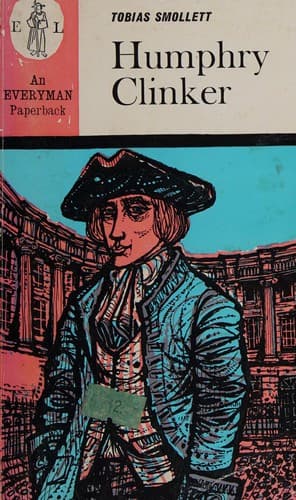
The Expedition of Humphry ClinkerSmollett, T. (Tobias)
General
The Expedition of Humphry Clinker
Smollett, T. (Tobias)
Epistolary fiction; Great Britain -- Fiction; Travelers -- Fiction
These observations served only to inflame her desire of knowing the
particulars about which she had enquired; and, with all his evasion,
he could not help discovering the following circumstances--that
his princess had neither shoes, stockings, shift, nor any kind of
linen--that her bridal dress consisted of a petticoat of red bays, and a
fringed blanket, fastened about her shoulders with a copper skewer; but
of ornaments she had great plenty.--Her hair was curiously plaited, and
interwoven with bobbins of human bone--one eye-lid was painted green,
and the other yellow; the cheeks were blue, the lips white, the teeth
red, and there was a black list drawn down the middle of the forehead
as far as the tip of the nose--a couple of gaudy parrot’s feathers were
stuck through the division of the nostrils--there was a blue stone set
in the chin, her ear-rings consisted of two pieces of hickery, of the
size and shape of drum-sticks--her arms and legs were adorned with
bracelets of wampum--her breast glittered with numerous strings of glass
beads--she wore a curious pouch, or pocket of woven grass, elegantly
painted with various colours--about her neck was hung the fresh scalp
of a Mohawk warrior, whom her deceased lover had lately slain in
battle--and, finally, she was anointed from head to foot with bear’s
grease, which sent forth a most agreeable odour.
One would imagine that these paraphernalia would not have been much
admired by a modern fine lady; but Mrs Tabitha was resolved to approve
of all the captains connexions.--She wished, indeed, the squaw had been
better provided with linen; but she owned there was much taste and
fancy in her ornaments; she made no doubt, therefore, that madam
Squinkinacoosta was a young lady of good sense and rare accomplishments,
and a good christian at bottom. Then she asked whether his consort had
been high church or low-church, presbyterian or anabaptist, or had been
favoured with any glimmering of the new light of the gospel? When he
confessed that she and her whole nation were utter strangers to the
christian faith, she gazed at him with signs of astonishment, and
Humphry Clinker, who chanced to be in the room, uttered a hollow groan.
After some pause, ‘In the name of God, captain Lismahago (cried she),
what religion do they profess?’ ‘As to religion, madam (answered
the lieutenant), it is among those Indians a matter of great
simplicity--they never heard of any Alliance between Church and
State.--They, in general, worship two contending principles; one the
Fountain of all Good, the other the source of all evil. The common
people there, as in other countries, run into the absurdities of
superstition; but sensible men pay adoration to a Supreme Being, who
created and sustains the universe.’ ‘O! what pity (exclaimed the pious
Tabby), that some holy man has not been inspired to go and convert these
poor heathens!’
Public-domain text, read in full here on John Shaqi.
Reviews
Reviews
No reviews yet
Be the first to share your thoughts on this work.
Elsewhere in the archive
Join the Discussion
Join the discussion
Sign in to leave a comment or review.
Sign InorCreate an account