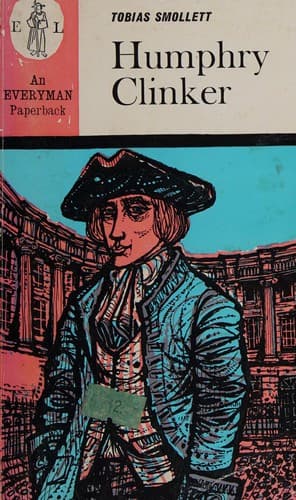
The Expedition of Humphry ClinkerSmollett, T. (Tobias)
General
The Expedition of Humphry Clinker
Smollett, T. (Tobias)
Epistolary fiction; Great Britain -- Fiction; Travelers -- Fiction
I desired to know his reasons for decrying some works, which had
afforded me uncommon pleasure; and, as demonstration did not seem to be
his talent, I dissented from his opinion with great freedom. Having been
spoiled by the deference and humility of his hearers, he did not bear
contradiction with much temper; and the dispute might have grown warm,
had it not been interrupted by the entrance of a rival bard, at whose
appearance he always quits the place--They are of different cabals, and
have been at open war these twenty years--If the other was dogmatical,
this genius was declamatory: he did not discourse, but harangue; and his
orations were equally tedious and turgid. He too pronounces ex cathedra
upon the characters of his contemporaries; and though he scruples not to
deal out praise, even lavishly, to the lowest reptile in Grubstreet who
will either flatter him in private, or mount the public rostrum as his
panegyrist, he damns all the other writers of the age, with the utmost
insolence and rancour--One is a blunderbuss, as being a native of
Ireland; another, a half-starved louse of literature, from the banks
of the Tweed; a third, an ass, because he enjoys a pension from the
government; a fourth, the very angel of dulness, because he succeeded in
a species of writing in which this Aristarchus had failed; a fifth, who
presumed to make strictures upon one of his performances, he holds as
a bug in criticism, whose stench is more offensive than his sting--In
short, except himself and his myrmidons, there is not a man of genius
or learning in the three kingdoms. As for the success of those, who have
written without the pale of this confederacy, he imputes it entirely to
want of taste in the public; not considering, that to the approbation of
that very tasteless public, he himself owes all the consequence he has
in life.
Those originals are not fit for conversation. If they would maintain the
advantage they have gained by their writing, they should never appear
but upon paper--For my part, I am shocked to find a man have sublime
ideas in his head, and nothing but illiberal sentiments in his
heart--The human soul will be generally found most defective in the
article of candour--I am inclined to think, no mind was ever wholly
exempt from envy; which, perhaps, may have been implanted, as an
instinct essential to our nature. I am afraid we sometimes palliate
this vice, under the spacious name of emulation. I have known a person
remarkably generous, humane, moderate, and apparently self-denying,
who could not hear even a friend commended, without betraying marks of
uneasiness; as if that commendation had implied an odious comparison
to his prejudice, and every wreath of praise added to the other’s
character, was a garland plucked from his own temples. This is a
malignant species of jealousy, of which I stand acquitted in my own
conscience.
Whether it is a vice, or an infirmity, I leave you to inquire.
Public-domain text, read in full here on John Shaqi.
Reviews
Reviews
No reviews yet
Be the first to share your thoughts on this work.
Elsewhere in the archive
Join the Discussion
Join the discussion
Sign in to leave a comment or review.
Sign InorCreate an account