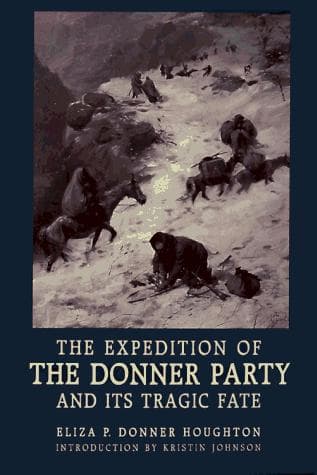
The Expedition of the Donner Party and its Tragic FateHoughton, Eliza Poor Donner
History
The Expedition of the Donner Party and its Tragic Fate
Houghton, Eliza Poor Donner
Donner Party; Overland journeys to the Pacific
Several resident families had also taken advantage of this privilege,
and elected to pay tuition and place their children under his
instruction, thus bringing together forty-nine energetic boys and girls
to whet each other's ambition and incite class rivalry. Among the
number were the five clever children of the Hon. Tod Robinson; three
sons of Judge Robert Robinson; Colonel Zabriskie's pretty daughter
Annie; Banker Swift's stately Margaret; General Redding's two sons; Dr.
Oatman's son Eugene; beloved Nelly Upton, daughter of the editor of
_The Sacramento Union_; Daniel Yost; Agnes Toll, the sweet singer; and
Eliza Denison, my chum.
At the end of the term, _The Daily Union_ closed its account of the
public examination of Jefferson Grammar School with the following
statement: "Among Mr. White's pupils are two young ladies, survivors of
the terrible disaster which befell the emigration of 1846 among the
snows of the California mountains."
Even this cursory reference was a matter of regret to Georgia and me.
We had entered school silent in regard to personal history, and did not
wish public attention turned toward ourselves even in an indirect way,
fearing it might lead to a revival of the false and sensational
accounts of the past, and we were not prepared to correct them, nor
willing they should be spread. Pursued by these fears, we returned to
the ranch, where Elitha and her three black-eyed little daughters
welcomed our home-coming and brightened our vacation.
Almost coincident, however, with the foregoing circumstance, Georgia
came into possession of "What I Saw in California," by Edwin Bryant;
and we found that the book did contain many facts in connection with
our party's disaster, but they were so interwoven with wild rumors, and
the false and sensational statements quoted from _The California Star_,
that they proved nothing, yet gave to the untrue that appearance of
truth which is so difficult to correct.
The language employed in description seemed to us so coarse and brutal
that we could not forgive its injustice to the living, and to the
memory of the dead. We could but feel that had simple facts been
stated, there would have been no harrowing criticism on account of long
unburied corpses found in the lake cabins. Nor would the sight of
mutilated dead have suggested that the starving survivors had become
"gloating cannibals, preying on the bodies of their companions." Bare
facts would have shown that the living had become too emaciated, too
weak, to dig graves, or to lift or drag the dead up the narrow snow
steps, even had open graves awaited their coming. Aye, more, would have
shown conclusively that mutilation of the bodies of those who had
perished was never from choice, never cannibalistic, but dire
necessity's last resort to ease torturing hunger, to prevent loss of
reason, to save life. Loss of reason was more dreaded than death by
the starving protectors of the helpless.
Public-domain text, read in full here on John Shaqi.
Reviews
Reviews
No reviews yet
Be the first to share your thoughts on this work.
Elsewhere in the archive
Join the Discussion
Join the discussion
Sign in to leave a comment or review.
Sign InorCreate an account