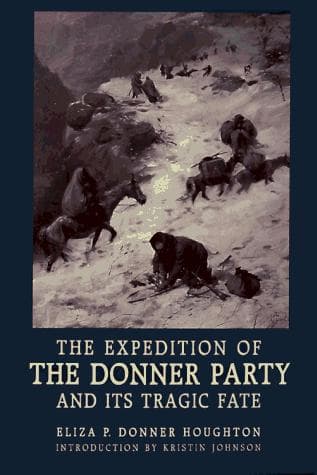
The Expedition of the Donner Party and its Tragic FateHoughton, Eliza Poor Donner
History
The Expedition of the Donner Party and its Tragic Fate
Houghton, Eliza Poor Donner
Donner Party; Overland journeys to the Pacific
Both were widows; the one had three, and the other four helpless
children to save. Was it culpable, or cannibalistic to seek and use the
only life-saving means left them? Were the acts and purposes of their
unsteady hands and aching hearts less tender, less humane than those of
the lauded surgeons of to-day, who infuse human blood from living
bodies into the arteries of those whom naught else can save, or who
strip skin from bodies that feel pain, to cover wounds which would
otherwise prove fatal?
John Baptiste Trubode and Nicholas Clark, of the Second Relief, were
the last men who saw my father alive. In August, 1883, the latter came
to my home in San Jose.
This was our second meeting since that memorable morning of March 2,
1847, when he went in pursuit of the wounded mother bear, and was left
behind by the relief party. We spoke long and earnestly of our
experience in the mountains, and he wished me to deny the statement
frequently made that, "Clark carried a pack of plunder and a heavy
shotgun from Donner's Camp and left a child there to die." This I can
do positively, for when the Third Relief Party took Simon Murphy and us
"three little Donner girls" from the mountain camp, not a living being
remained, except Mrs. Murphy and Keseberg at the lake camp, and my
father and mother at Donner's Camp. All were helpless except my mother.
The Spring following my interview with Nicholas Clark, John Baptiste
came to San Jose, and Mr. McCutchen brought him to talk with me. John,
always a picturesque character, had become a hop picker in hop season,
and a fisherman the rest of the year. He could not restrain the tears
which coursed down his bronzed cheeks as he spoke of the destitution
and suffering in the snow-bound camps; of the young unmarried men who
had been so light-hearted on the plains and brave when first they faced
the snows. His voice trembled as he told how often they had tried to
break through the great barriers, and failed; hunted, and found
nothing; fished, and caught nothing; and when rations dwindled to
strips of beef hide, their strength waned, and death found them ready
victims. He declared,
The hair and bones found around the Donner fires were those of
cattle. No human flesh was used by either Donner family. This I
know, for I was there all winter and helped get all the wood and
food we had, after starvation threatened us. I was about sixteen
years old at the time. Our four men died early in December and were
buried in excavations in the side of the mountain. Their bodies were
never disturbed. As the snows deepened to ten and twelve feet, we
lost track of their location.
When saying good-bye, he looked at me wistfully and exclaimed: "Oh,
little Eliza, sister mine, how I suffered and worked to help keep you
alive. Do you think there was ever colder, stronger winds than them
that whistled and howled around our camp in the Sierras?"
Public-domain text, read in full here on John Shaqi.
Reviews
Reviews
No reviews yet
Be the first to share your thoughts on this work.
Elsewhere in the archive
Join the Discussion
Join the discussion
Sign in to leave a comment or review.
Sign InorCreate an account