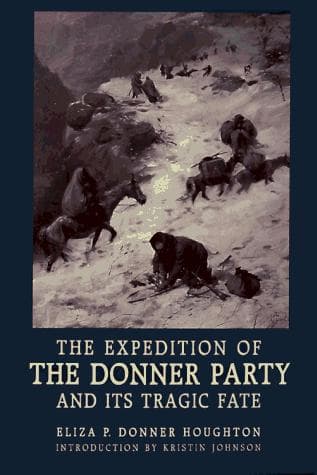
The Expedition of the Donner Party and its Tragic FateHoughton, Eliza Poor Donner
History
The Expedition of the Donner Party and its Tragic Fate
Houghton, Eliza Poor Donner
Donner Party; Overland journeys to the Pacific
It is also plain that the Fallon Party did not set out expecting to
find any one alive in the mountains, otherwise would it not have taken
more provisions than just enough to sustain its own men ten days? Would
it not have ordered more horses to meet it at the lower end of Bear
Valley for the return trip? Had it planned to find and succor survivors
would it have taken it for granted that all had perished, simply
because there was no one in the lake cabins, and would it have delayed
two precious hours in searching the lake camp for valuables before
proceeding to Donner's Camp?
Had the desire to rescue been uppermost in mind, would not the sight of
human foot-tracks on the snow half way between the two camps have
excited hope, instead of "suspicion," and prompted some of the party to
pursue the lone wanderer with kindly intent? Does not each succeeding
day's entry in that journal disclose the party's forgetfulness of its
declared mission to the mountains? Can any palliating excuse be urged
why those men did not share with Keseberg the food they had brought,
instead of permitting him to continue that which famine had forced upon
him, and which later they so righteously condemned?
Is there a single strain of humanity, pathos, or reverence in that
diary, save that reflected from Keseberg's last act before being
hurried away from that desolate cabin? Or could there be a falser,
crueler, or more heartless account brought to bereaved children than
Fallon's purported description of the father's body found in Donner's
Camp?
Here is the statement of Edwin Bryant, who with General Kearney and
escort, _en route_ to the United States, halted at the deserted cabins
on June 22, 1847, and wrote:
The body of (Captain) George Donner was found in his own camp about
eight miles distant. He had been carefully laid out by his wife, and
a sheet was wrapped around the corpse. This sad office was probably
the last act she performed before visiting the camp of Keseberg.[30]
After considering what had been published by _The California Star_, by
Bryant, Thornton, Mrs. Farnham, and others, I could not but realize
Keseberg's peculiarly helpless situation. Without a chance to speak in
his own defence, he had been charged, tried, and adjudged guilty by his
accusers; and an excited people had accepted the verdict without
question. Later, at Captain Sutter's suggestion, Keseberg brought
action for slander against Captain Fallon and party. The case was tried
before Alcalde Sinclair,[31] and the jury gave Keseberg a verdict of
one dollar damages. This verdict, however, was not given wide
circulation, and prejudice remained unchecked. There were other
peculiar circumstances connected with this much accused man which were
worthy of consideration, notably the following: If, as reported,
Keseberg was in condition to walk to the settlement, why did the First
Relief permit him to remain in camp consuming rations that might have
saved others?
Public-domain text, read in full here on John Shaqi.
Reviews
Reviews
No reviews yet
Be the first to share your thoughts on this work.
Elsewhere in the archive
Join the Discussion
Join the discussion
Sign in to leave a comment or review.
Sign InorCreate an account