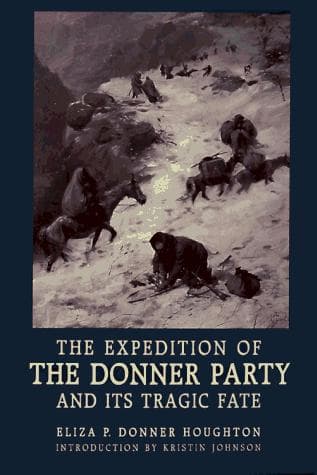
The Expedition of the Donner Party and its Tragic FateHoughton, Eliza Poor Donner
History
The Expedition of the Donner Party and its Tragic Fate
Houghton, Eliza Poor Donner
Donner Party; Overland journeys to the Pacific
Every day or two a horse all white with lather and dripping with sweat
would rush by, and the Indian or white man on his back would guide him
straight to Captain Kerns' quarters, where he would hand out papers and
letters. The women and children would flock thither to see if it meant
news for them. Often they were disappointed and talked a great deal
about the tediousness of the Mexican War and the delays of Captain
Frémont's company. They wanted the war to end, and their men folk back
so that they could move and get to farming before it should be too late
to grow garden truck for family use.
While they thus anxiously awaited the return of their soldiers, we kept
watch of the cow-path by which we had reached the Fort; for Elitha had
told us that we might "pretty soon see the relief coming." She did not
say, "with father and mother"; but we did, and she replied, "I hope
so."
We were very proud of the new clothes she had made us; but the first
time she washed and hung them out to dry, they were stolen, and we were
again destitute. Sister Elitha thought perhaps strange Indians took
them.
In May, the Fallon party arrived with horses laden with many packs of
goods, but their only refugee was Lewis Keseberg, from the cabin near
the lake.
It was evening, and some one came to our door, spoke to Elitha and
Leanna in low tones and went away. My sisters turned, put their arms
about us and wept bitterly. Then, gently, compassionately, the cruel,
desolating truth was told. Ah, how could we believe it? No anxious
watching, no weary waiting would ever bring father and mother to us
again!
[Footnote 13: Thornton.]
CHAPTER XVII
ORPHANS--KESEBERG AND HIS ACCUSERS--SENSATIONAL ACCOUNTS OF THE TRAGEDY
AT DONNER LAKE--PROPERTY SOLD AND GUARDIAN APPOINTED--KINDLY
INDIANS--"GRANDPA"--MARRIAGE OF ELITHA.
The report of our affliction spread rapidly, and the well-meaning,
tender-hearted women at the Fort came to condole and weep with us, and
made their children weep also by urging, "Now, do say something
comforting to these poor little girls, who were frozen and starved up
in the mountains, and are now orphans in a strange land, without any
home or any one to care for them."
Such ordeals were too overwhelming. I would rush off alone among the
wild flowers to get away from the torturing sympathy. Even there, I met
those who would look at me with great serious eyes, shake their heads,
and mournfully say, "You poor little mite, how much better it would be
if you had died in the mountains with your dear mother, instead of
being left alone to struggle in this wicked world!"
This would but increase my distress, for I did not want to be dead and
buried up there under the cold, deep snow, and I knew that mother did
not want me to be there either. Had she not sent me away to save me,
and asked God, our Heavenly Father, to take care of me?
Public-domain text, read in full here on John Shaqi.
Reviews
Reviews
No reviews yet
Be the first to share your thoughts on this work.
Elsewhere in the archive
Join the Discussion
Join the discussion
Sign in to leave a comment or review.
Sign InorCreate an account