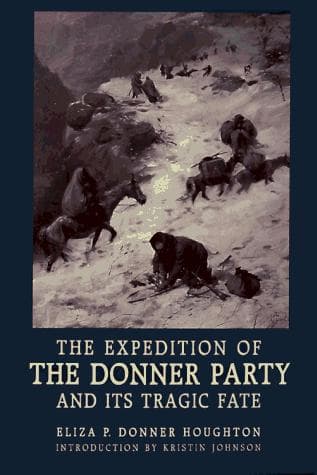
The Expedition of the Donner Party and its Tragic FateHoughton, Eliza Poor Donner
History
The Expedition of the Donner Party and its Tragic Fate
Houghton, Eliza Poor Donner
Donner Party; Overland journeys to the Pacific
Grandma was as happy as I. She could understand English better than she
could speak it, and in answering my questions, explained largely by
signs. "Courage," her gray poodle, left deep footprints in the dust,
as he trotted ahead over the well-known road, and I felt an increasing
affection for him upon learning that he, too, had crossed the plains in
an emigrant wagon and had reached the Fort at about the same time I had
reached the snow. He was so small that I imagined he must have been a
wee baby dog when he started, and that he was not yet half grown. My
surprise and admiration quickened beyond expression when grandma
assured me that he could do many tricks, understood French and German,
and was learning English.
Then she laughed, and explained that he was thus accomplished because
she and Christian Brunner, her husband, and Jacob, her brother-in-law,
had come from a place far away across lands and big waters where most
of the people spoke both French and German and that they had always
talked to Courage in one or the other of these languages.
As soon as we got into the house she opened the back door and called
"Jacob!" Then turning, she took a small cup of rennet clabber from the
shelf, poured a little cream over it, put a spoon in it, and set it on
the table before me. While I was eating, a pleasant elderly man came in
and by nods, motions, and words, partly English and partly something
else, convinced me that he liked little girls, and was glad to see me.
Then of a sudden, he clasped his hands about my waist and tossed me in
the air as father did before his hand was hurt, and when he wanted to
startle me, and then hear me laugh. This act, which brought back
loving memories, made Jacob seem nearer to me; nearer still when he
told me I must not call him anything but Jakie.
Everything about the house was as Georgia had described. Even the big
stick she had used to keep the old sheep from butting her over was
behind the door where she had left it.
When Christian Brunner got home from the Fort, grandma had supper
nearly ready, and he and I were friends the instant we looked into each
other's face; for he was "grandpa" who had given us the liver the
evening we did not find our sisters. He had gone home that night and
said: "Mary, at the Fort are three hungry little orphan girls. Take
them something as soon as you can. One child is fair, two are dark. You
will know them by the way they speak to you."
Grandpa had now hastened home to hold me on his lap and to hear me say
that I was glad to be at his house and intended to help grandma all I
could for being so good as to bring me there. After I told how we had
cooked the liver and how good it tasted, he wiped his eyes and said:
"Mine child, when you little ones thanked me for that liver, it made me
not so much your friend as when you called me 'grandpa.'"
Public-domain text, read in full here on John Shaqi.
Reviews
Reviews
No reviews yet
Be the first to share your thoughts on this work.
Elsewhere in the archive
Join the Discussion
Join the discussion
Sign in to leave a comment or review.
Sign InorCreate an account