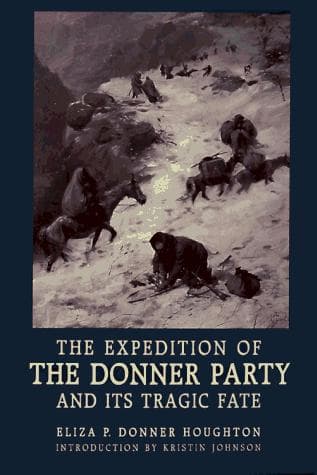
The Expedition of the Donner Party and its Tragic FateHoughton, Eliza Poor Donner
History
The Expedition of the Donner Party and its Tragic Fate
Houghton, Eliza Poor Donner
Donner Party; Overland journeys to the Pacific
Jakie was busy and useful at both places, but grandpa was owner of the
shop, and grandma of the dairy. Her hand had the cunning of the Swiss
cheese-maker, and the deftness of the artist in butter moulding. She
was also an experienced cook, and had many household commodities
usually unknown to pioneer homes. They were thus eminently fitted for
life in a crude new settlement, and occupied an important place in the
community.
A public road cut their land into two unequal parts. The cattle corrals
and sheds were grouped on one side of the road, and the family
accommodations on the other. Three magnificent oaks and a weird,
blackened tree-trunk added picturesqueness to the ground upon which the
log cabin and outbuildings stood. The trim live oak shaded the adobe
milk-room and smoke-house, while the grand old white oak spread its
far-reaching boughs over the curbed well and front dooryard.
[Illustration: PLAZA AND BARRACKS OF SONOMA]
[Illustration: ONE OF THE OLDEST BUILDINGS IN SONOMA]
The log cabin was a substantial three-roomed structure. Its two outer
doors opened with latch strings and were sawed across just above the
middle, so that the lower sections might be kept closed against the
straying pigs and fowls, while the upper part remained open to help the
windows opposite give light and ventilation. The east end formed the
ample store-room with shelves for many stages of ripening cheese. The
west end served as sleeping apartment for all except Jakie. The large
middle room was set apart as kitchen and general living room.
Against its wall were braced the dear old clock and conveniences for
holding dishes, and the few keepsakes which had shared the wanderings
of their owners on two continents.
The adobe chimney, which formed part of the partition between the
living and the sleeping apartment, gave a huge fireplace to each. From
the side of the one that cheered the living room, swung a crane worthy
of the great copper cheese kettle that hung on its arm. In tidy rows on
the chimney shelf stood bottles and boxes of medicine, two small brass
kettles, and six bright candlesticks with hoods, trays, and snuffers to
match. On the wide hearth beneath were ranged the old-fashioned
three-legged iron pots, dominated by the large round one, used as a
bake oven. Hovering over the fire sat the iron tea-kettle, with its
slender throat and pointed lips, now warmed to song by the blazing
logs, now rattling its lid with increasing fervor.
A long table with rough redwood benches around it, a few
straight-backed chairs against the wall, and Jakie's half-concealed
bed, in the far corner, constituted the visible furnishings of this
memorable room, which was so spick and span in German order and
cleanliness, that even its clay floor had to be sprinkled in regular
spots and rings before being swept.
Public-domain text, read in full here on John Shaqi.
Reviews
Reviews
No reviews yet
Be the first to share your thoughts on this work.
Elsewhere in the archive
Join the Discussion
Join the discussion
Sign in to leave a comment or review.
Sign InorCreate an account