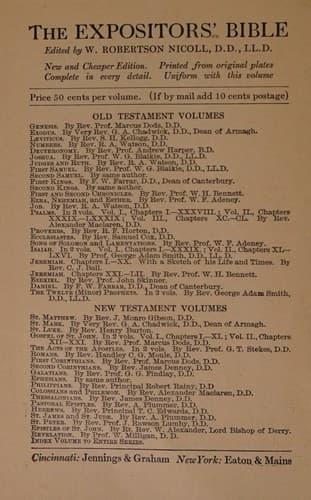
The Expositor's Bible: The Book of RevelationMilligan, William
Philosophy
The Expositor's Bible: The Book of Revelation
Milligan, William
Bible. Revelation -- Commentaries
And the second angel sounded, and as it were a great mountain
burning with fire was cast into the sea: and the third part of the
sea became blood; and there died the third part of the creatures
which were in the sea, even they that had life; and the third part
of the ships was destroyed (viii. 8, 9).
As the first Trumpet affected the land, so the second affects _the
sea_; and the remarks already made upon the one destruction are for
the most part applicable to the other. The figure of removing a
mountain from its place and casting it into the sea was used by our
Lord to express what beyond all else it was impossible to accomplish
by mere human power: "Verily I say unto you, If ye have faith, and
doubt not, ye shall not only do what is done to the fig tree, but even
if ye shall say unto this mountain, Be thou taken up and cast into the
sea, it shall be done."[205] In so speaking, our Lord had followed the
language of the prophets, who were accustomed to illustrate by the
thought of the removal of mountains the greatest acts of Divine power:
"What art thou, O great mountain? before Zerubbabel thou shalt become
a plain;" "Therefore will we not fear, though the mountains be carried
into the midst of the seas."[206]
Even the figure of a "burnt mountain" is not strange to the Old
Testament, for the prophet Jeremiah thus denounces woe on Babylon:
"Behold, I am against thee, O destroying mountain, saith the Lord, which
destroyest all the earth: and I will stretch out Mine hand upon thee,
and roll thee down from the rocks, and make thee a burnt mountain."[207]
The plagues of Egypt, too, are again taken advantage of by the Seer,
for in the first of these Moses "lifted up the rod, and smote the
waters that were in the river; ... and all the waters that were in the
river were turned to blood. And the fish that was in the river died;
and the river stank, and the Egyptians could not drink of the water of
the river; and there was blood throughout all the land of Egypt."[208]
Here, however, the plague is extended, embracing as it does not only
the river of Egypt, but the sea, with all the ships that sail upon it,
and all its fish. Again also, as before, the "third part" is not to be
thought of as confined to one region of the ocean, while the
remaining two-thirds are left untouched. It is to be sought everywhere
over the whole compass of the deep.
The third Trumpet is now blown:--
And the third angel sounded, and there fell from heaven a great
star, burning as a torch, and it fell upon the third part of the
rivers, and upon the fountains of the waters; and the name of the
star is called Wormwood: and the third part of the waters became
wormwood; and many men died of the waters, because they were made
bitter (viii. 10, 11).
Public-domain text, read in full here on John Shaqi.
Reviews
Reviews
No reviews yet
Be the first to share your thoughts on this work.
Elsewhere in the archive
Join the Discussion
Join the discussion
Sign in to leave a comment or review.
Sign InorCreate an account