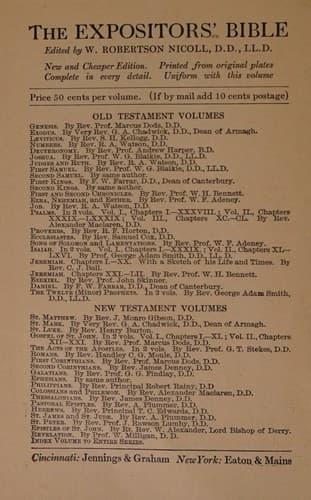
The Expositor's Bible: The Book of RevelationMilligan, William
Philosophy
The Expositor's Bible: The Book of Revelation
Milligan, William
Bible. Revelation -- Commentaries
Light is thus thrown also upon the second point above mentioned: the
particular conflict referred to in these verses. The statement that
_there was war in heaven_, and that when the dragon was defeated he
was _cast down into the earth_, might lead us to think of an earlier
conflict between good and evil than any in which man has part: of that
mentioned by St. Peter and St. Jude, when the former consoles the
righteous by the thought that "God spared not angels when they sinned,
but cast them down to hell, and committed them to pits of darkness, to
be reserved unto judgment,"[310] and when the latter warns sinners to
remember that "angels which kept not their own principality, but left
their proper habitation, He hath kept in everlasting bonds under
darkness unto the judgment of the great day."[311] The circumstances,
however, of the war, lead rather to the thought of a conflict in
which the Son, incarnate and glorified, takes His part. For _this_
"Son" is the opponent of the dragon introduced to us in the first
paragraph of the chapter. "Heaven" is not so much a premundane or
supramundane locality as the spiritual sphere within which believers
dwell even during their earthly pilgrimage, when that pilgrimage is
viewed upon its higher side. And the means by which the victory is
gained--for the victors _overcame by the blood of the Lamb, and by the
word of their testimony_--distinctly indicate that the struggle
referred to took place after the work of redemption had been
completed, not before it was begun.
Public-domain text, read in full here on John Shaqi.
Reviews
Reviews
No reviews yet
Be the first to share your thoughts on this work.
Elsewhere in the archive
Join the Discussion
Join the discussion
Sign in to leave a comment or review.
Sign InorCreate an account