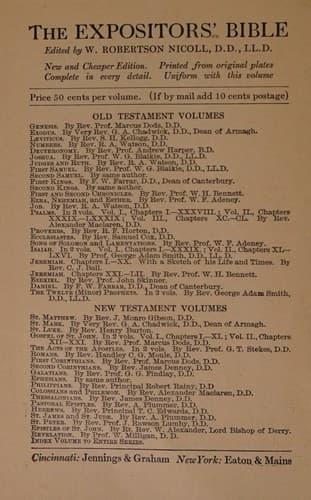
The Expositor's Bible: The Book of RevelationMilligan, William
Philosophy
The Expositor's Bible: The Book of Revelation
Milligan, William
Bible. Revelation -- Commentaries
In passages such as these we have the same thought as that before us
in this vision. Satan has been cast out of heaven; that is, _in his
warfare against the children of God he has been completely
overthrown_. Over their higher life, their life in a risen and
glorified Redeemer, he has no power. They are for ever escaped from
his bondage, and are free. But he has been _cast down into the earth,
and his angels with him_; that is, over the _men of the world_ he
still exerts his power, and they are led captive by him at his will.
Hence, accordingly, the words of the _great voice_ heard in heaven
which occupy all the latter part of the vision, words which distinctly
bring out the difference between the two aspects of Satan now adverted
to,--(1) his impotence as regards the disciples of Jesus who are
faithful unto death: _Rejoice, O heavens, and ye that dwell in them_;
(2) his mastery over the ungodly: _Woe for the earth and for the sea!
for the devil is gone down unto you in great wrath, knowing that he
hath but a short season._ Although, therefore, the fall of the angels
from their first estate may be remotely hinted at, the vision refers
to the spiritual contest begun after the resurrection of Jesus; and we
ask our readers only to pay particular regard to the double relation
of Satan to mankind which is referred to in it: his subjection to the
righteous and the subjection of the wicked to him. One phrase only may
seem inconsistent with this view. In ver. 9 Satan is described as _the
deceiver of the whole inhabited earth_, for that, and not "the whole
world," is the true rendering of the original.[315] "The whole
inhabited earth" cannot be the same as "the earth." The latter is
simply the wicked; the former includes all men. But the words describe
a characteristic of Satan in himself, and not what he actually
effects. He _is_ the deceiver of the whole inhabited earth. He lays
his snares for all. He tempted Jesus Himself in the wilderness, and
many a time thereafter during His labours and His sufferings. The
vision gives no ground for the supposition that God's children are not
_attacked_ by him. It assures us only that when the attack is made it
is at the same instant foiled. There is a battle, but Christians
advance to it as conquerors; before it begins victory is theirs.[316]
One other expression of these verses may be noted: the _short season_
spoken of in ver. 12. This period of time is not to be looked at as if
it were a brief special season at the close of the Christian age,
when the wrath of Satan is aroused to a greater than ordinary degree
because the last hour is about to strike. The _great wrath_ with which
he goes forth is that stirred in him by his defeat through the death,
resurrection, and ascension of our Lord. It was roused in him when he
was "cast into the earth," and from that moment of defeat therefore
the "short season" begins.
The third paragraph of the chapter follows:--
Public-domain text, read in full here on John Shaqi.
Reviews
Reviews
No reviews yet
Be the first to share your thoughts on this work.
Elsewhere in the archive
Join the Discussion
Join the discussion
Sign in to leave a comment or review.
Sign InorCreate an account