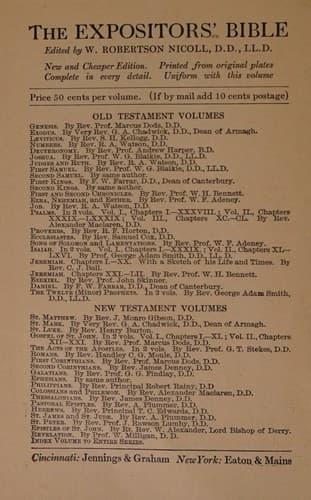
The Expositor's Bible: The Book of RevelationMilligan, William
Philosophy
The Expositor's Bible: The Book of Revelation
Milligan, William
Bible. Revelation -- Commentaries
The whole description of the beast is thus, in multiplied particulars,
a travesty of the Lord Jesus Christ Himself, the Head and King, the
Guardian and Protector, of His people. Like the latter, the former is
the representative, the "sent," of an unseen power, by whom all
authority is "given" him; he has his death and his resurrection from
the dead; he has his throngs of marvelling and enthusiastic
worshippers; his authority over those who own his sway is limited by
no national boundaries, but is conterminous with the whole world; he
gathers up and unites in himself all the scattered elements of
darkness and enmity to the truth which had previously existed among
men, and from which the Church of God had suffered.
What then can this first beast be? Not Rome, either pagan or papal;
not any single form of earthly government, however strong; not any
Roman emperor, however vicious or cruel; but the general influence of
the world, in so far as it is opposed to God, substituting the human
for the Divine, the seen for the unseen, the temporal for the eternal.
He is the impersonation of that world of which St. Paul writes, "We
received, not the spirit of the world, but the spirit which is of
God,"[351] of which St. James speaks when he says, "Whosoever
therefore would be a friend of the world maketh himself an enemy of
God,"[352] and in regard to which St. John exhorts, "Love not the
world, neither the things that are in the world. If any man love the
world, the love of the Father is not in him. For all that is in the
world, the lust of the flesh, and the lust of the eyes, and the
vain-glory of life, is not of the Father, but is of the world."[353]
This beast, in short, is the world viewed in that aspect in which our
Lord Himself could say of it that the devil was its prince, which He
told His disciples He had overcome, and in regard to which He prayed
in His high-priestly prayer, "I pray not that Thou shouldest take them
out of the world, but that Thou shouldest keep them out of the evil
one. They are not of the world, even as I am not of the world."[354]
The influence of the beast here spoken of is therefore confined to no
party, or sect, or age. It may be found in the Church and in the State,
in every society, in every family, or even in every heart, for wherever
man is ruled by the seen instead of the unseen or by the material
instead of the spiritual, there "the world" is. "Our wrestling is not
against flesh and blood, but against the principalities, against the
powers, against the world-rulers of this darkness, against the spiritual
hosts of wickedness in the heavenly places."[355]
Public-domain text, read in full here on John Shaqi.
Reviews
Reviews
No reviews yet
Be the first to share your thoughts on this work.
Elsewhere in the archive
Join the Discussion
Join the discussion
Sign in to leave a comment or review.
Sign InorCreate an account