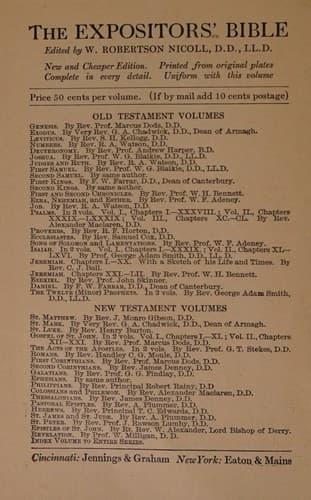
The Expositor's Bible: The Book of RevelationMilligan, William
Philosophy
The Expositor's Bible: The Book of Revelation
Milligan, William
Bible. Revelation -- Commentaries
At this point, after the thought of that spirit of allegiance to the
beast which draws down such terrors upon itself, and before we reach the
central figure of the whole movement, we have some words of comfort
interposed. The meaning of the first part of them is similar to that of
chap. xiii. 10, and need not be further spoken of. The meaning of their
second part, conveying to us the contents of the "voice from heaven,"
demands a moment's notice. _Blessed_, exclaims the heavenly voice (at
the same time prefixing the command _Write_), _are the dead which die in
the Lord from henceforth_. It is difficult to determine the precise
point of time referred to in the word "henceforth." If it be the moment
of the end, the moment of the Second Coming of the Lord, then the
promise must express the glory of the resurrection. But, to say nothing
of the fact that "resting from labours" is too weak to bring out the
glory of the resurrection state, there is at that instant no more time
to die in the Lord. The living shall be "changed." It seems better,
therefore, to understand the words as a voice of consolation running
throughout the whole Christian age. In the view of "heaven" the lapse of
time is hardly thought of. All is Now. The meaning of "dying in the
Lord," again, must not be regarded as equivalent to the Scriptural
expression "falling asleep in Jesus." Not the thought of "falling
asleep" in a quiet Christian home, but of "dying" as Jesus died, is in
the Seer's mind; and not the thought of rest from work, but of rest from
_toils_, an entirely different and far stronger word, is in the answer
of the Spirit. Thus are believers blessed. Their life is a life of toil,
of hardship, of trial, of persecution, of death; but when they die, they
"rest." And their "works"--that is, their Christian character and
life--are not lost. They _follow with them_, and meet them again in the
heavenly mansions as the record of all that they have done and suffered
in their Master's cause.
The first three angels have accomplished their task. We now reach the
fourth and chief member in this series of seven, and meet with the Lord
as He comes to take His people to Himself, that where He is, there they
may also be. That it is the Lord who is here before us we cannot for a
moment doubt. The designation _like unto a Son of man_, the same as that
of chap. i. 13, itself establishes the fact, which is again confirmed by
the mention of the _white cloud_ and of the _golden crown_. _In His
hand_ He holds _a sharp sickle_, with which to reap. Thus also in
different passages of the New Testament our Lord speaks of the harvest
of His people, although in them He acts by His angels and Apostles.[404]
In one passage of the Gospel of St. John He acts by Himself.[405] The
glorified Redeemer is thus ready to complete His work.
Public-domain text, read in full here on John Shaqi.
Reviews
Reviews
No reviews yet
Be the first to share your thoughts on this work.
Elsewhere in the archive
Join the Discussion
Join the discussion
Sign in to leave a comment or review.
Sign InorCreate an account