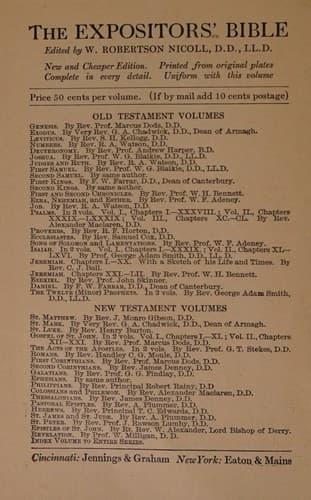
The Expositor's Bible: The Book of RevelationMilligan, William
Philosophy
The Expositor's Bible: The Book of Revelation
Milligan, William
Bible. Revelation -- Commentaries
We have now reached the close of the longest and most important section
of the Apocalypse, beginning, as has been already pointed out, with
chap. vi. It is the fourth in that series of seven of which the book is
composed; and the main purpose of St. John in writing finds expression
in it. As the writer of the fourth Gospel describes in the fourth
section of that book, extending from chap. v. to chap. xii., the
conflict between the Son of God and "the Jews," so he describes in the
corresponding section of the Apocalypse the conflict between the
glorified Son of man as He lives and reigns in His Church and the evil
of the world. Throughout the conflict we are not once permitted to
forget that, although Christ and the true members of His Body may be the
objects of attack, and may even have to retire for security from the
field, God is on their side, and will never suffer His faithfulness to
fail or forget His promises. In a threefold series of judgments the
guilty world and the guilty Church are visited with the terrors of His
wrath. These three series of judgments, too, go on in an ascending line.
The climactic character of their contents has already been pointed out,
and nothing more need be said of it. But it may be worth while to notice
that the element of climax appears not less in the nature of the
instruments employed. Comparing the Trumpets with the Seals, the simple
fact that they are Trumpets indicates a higher, more exciting, more
terrible unfolding of wrath. The Trumpet is peculiarly the warlike
instrument, summoning the hosts to battle: "Thou hast heard, O my soul,
the sound of the trumpet, the alarm of war;" "That day is a day of
wrath, a day of trouble and distress, a day of wasteness and desolation,
a day of darkness and gloominess, a day of clouds and thick darkness, a
day of the trumpet and alarm against the fenced cities."[494] That the
Bowls, again, are still more potent than the Trumpets, appears from the
language in which they are described, from their mode of introduction,
and from the vessels made use of for the plagues. They are "the last"
plagues; in them is "finished" the wrath of God; they are called for by
a "great voice out of the sanctuary;" and they proceed, not from a
secular instrument, however warlike, but from a sacred vessel, not from
one which must be sounded for a length of time before it produces its
effect, but from one which, inverted in a moment, pours out with a
sudden gush its terrors upon men. Similar though they thus are, the
three series of judgments lose what might otherwise be their sameness;
and the mind is invited to rest upon that most instructive lesson of the
providence of God, that in proportion to privilege misused is the
severity with which sin is punished. Throughout all these judgments the
righteous are kept safe.
Public-domain text, read in full here on John Shaqi.
Reviews
Reviews
No reviews yet
Be the first to share your thoughts on this work.
Elsewhere in the archive
Join the Discussion
Join the discussion
Sign in to leave a comment or review.
Sign InorCreate an account