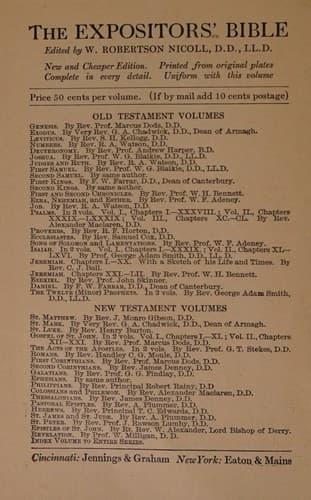
The Expositor's Bible: The Book of RevelationMilligan, William
Philosophy
The Expositor's Bible: The Book of Revelation
Milligan, William
Bible. Revelation -- Commentaries
5. The use of numbers in the Apocalypse ought to be remembered. These
numbers are invariably symbolical; and, if the number a thousand is to
be here interpreted literally, it seems in that respect to stand
alone. Nor is it a reply to this to say that, though not in the strict
sense literal, it may signify a period of _indefinite_ length. Such an
interpretation would be not less opposed than the former to the genius
and spirit of this book. The numbers of the Apocalypse have always a
_definite_ meaning. They express ideas, but the ideas are distinct.
They may belong to a region of thought different from that with which
arithmetical numbers are concerned, but within that region we cannot
change their value without at the same time changing the thought. We
are not to imagine that numbers, in the allegorical or spiritual use
made of them by the Jews, might be tossed about at their pleasure or
shuffled like a pack of cards. They were a language; and the bond
between them and the ideas that they involved was quite as close as it
is between the words of ordinary speech and the speaker's thoughts. A
thousand years cannot mean two, or ten, or twenty, or three hundred
and sixty-five thousand years according as we please. If they are a
measure of time, the measure must be fixed; and we ought to be able to
explain the principle leading us to attach to the number one thousand
a value different from that which it naturally possesses.
6. The teaching of Scripture elsewhere upon this subject has to be
considered. Upon this point it is unnecessary to say much, for the
difference between that teaching and any view commonly taken of the
thousand years' reign is acknowledged. It ought to be observed, however,
that this difference is not merely negative, as if the rest of the New
Testament simply failed to fill in certain details of events more
largely described in the Apocalypse, but upon the whole substantially
the same. The difference is also positive, and in some respects
irreconcilable with what we are taught by the other sacred writers. The
New Testament, unless this passage be an exception, always brings the
_Parousia_ and the general judgment into the closest possible connexion.
It nowhere interposes a lengthened period between the resurrection of
believers and that of unbelievers. It knows only of one, and that a
general, resurrection; and the passages, such as 1 Cor. xv. 23, 24, and
1 Thess. iv. 16, 17, usually quoted to support another conclusion, fail
when correctly interpreted to do so. When our Lord comes again, He at
once perfects the happiness of His saints and makes all His enemies His
footstool.[539] One text alone may be quoted upon this point. While the
"first resurrection" is assigned to a date a thousand or even thousands
of years before the end, it is several times repeated in the discourse
of Jesus in the sixth chapter of St. John that the resurrection of
believers takes place at the "last day."[540]
Public-domain text, read in full here on John Shaqi.
Reviews
Reviews
No reviews yet
Be the first to share your thoughts on this work.
Elsewhere in the archive
Join the Discussion
Join the discussion
Sign in to leave a comment or review.
Sign InorCreate an account