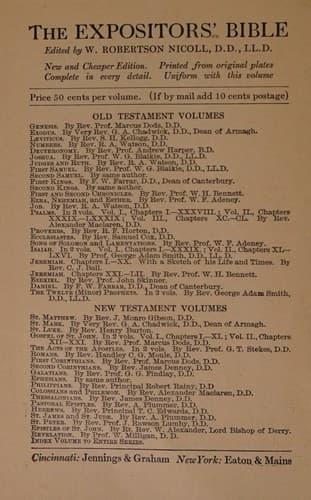
The Expositor's Bible: The Book of RevelationMilligan, William
Philosophy
The Expositor's Bible: The Book of Revelation
Milligan, William
Bible. Revelation -- Commentaries
And I saw a new heaven and a new earth: for the first heaven and
the first earth are passed away; and the sea is no more. And I saw
the holy city, new Jerusalem, coming down out of heaven from God,
made ready as a bride adorned for her husband. And I heard a great
voice out of the throne saying, Behold, the tabernacle of God is
with men, and He shall dwell with them, and they shall be His
peoples, and God Himself shall be with them, and be their God: and
He shall wipe away every tear from their eyes; and death shall be
no more, neither shall there be mourning, nor crying, nor pain any
more: the first things are passed away. And He that sitteth on the
throne said, Behold, I make all things new. And He saith, Write:
for these words are faithful and true. And He said unto me, They
are come to pass. I am the Alpha and the Omega, the beginning and
the end. I will give unto him that is athirst of the fountain of
the water of life freely. He that overcometh shall inherit these
things; and I will be his God, and he shall be My son. But for the
fearful, and unbelieving, and abominable, and murderers, and
fornicators, and sorcerers, and idolaters, and all liars, their
part shall be in the lake that burneth with fire and brimstone:
which is the second death (xxi. 1-8).
These words, like many others that have already met us, throw light
upon the principles on which the Apocalypse is composed. They show in
the clearest possible manner that down to the very end of the book
chronological considerations must be put out of view. Chronology
cannot be thought of when we find, on the one hand, allusions to the
new Jerusalem which are only amplified and extended in the next vision
of the chapter, or when we find, on the other hand, a description of
the exclusion from the new Jerusalem of certain classes that have
already been consigned to "the second death." By the first-mentioned
allusions the passage connects itself with what is yet to come, by the
second with what has gone before. For the same reason it is
unnecessary to dwell upon the passage at any length. It contains
either nothing new, or nothing that will not again meet us in greater
fulness of detail. One or two brief remarks alone seem called for.
Public-domain text, read in full here on John Shaqi.
Reviews
Reviews
No reviews yet
Be the first to share your thoughts on this work.
Elsewhere in the archive
Join the Discussion
Join the discussion
Sign in to leave a comment or review.
Sign InorCreate an account